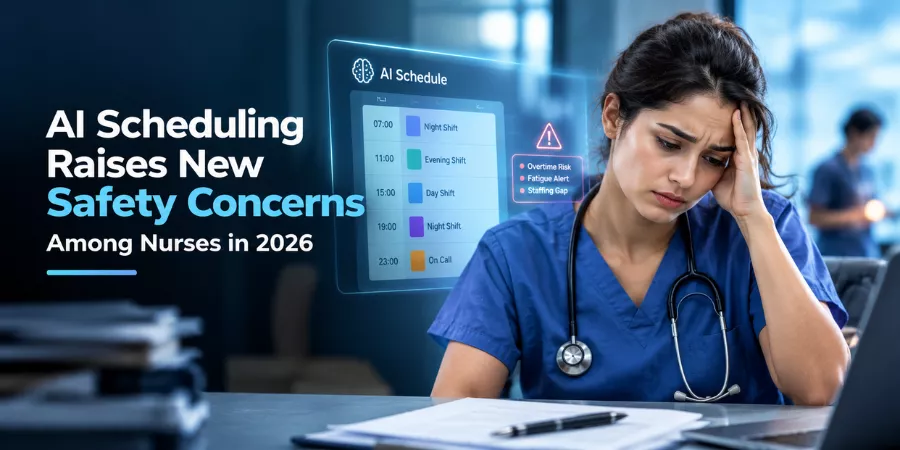
AI is making its way into hospital corners promising to improve the efficiency of healthcare, but the concern being raised by nurses is different, what if it affects the nurses?
Nursing staff has received these reports on AI driven scheduling and monitoring tool- it is creating frustration among nurse, from staffing issue, workload to monitoring and patients’ safety.
Why Are Nurses Concerned About AI Scheduling?
AI scheduling systems are designed to match staffing levels, patient demand, skills and employee availability. At HCA Healthcare, a Palantir-powered system called Timpani has been deployed across roughly 130 of the company’s 190 locations since 2023, but nurses interviewed by WIRED say the technology has sometimes produced schedules that ignore their preferences and create difficult staffing combinations.
Several nurses told WIRED that the system can place too few experienced nurses on a shift or schedule workers for consecutive days that leave them exhausted. One nurse described situations in which she was the only senior nurse among several junior colleagues, forcing her to spend time supporting less experienced staff instead of focusing entirely on patients. These are allegations from nurses, while HCA maintains that nursing leaders make the final scheduling decisions.
The concern, therefore, is not simply whether an algorithm can create a roster faster. The bigger question is whether a scheduling system can understand the clinical context behind staffing decisions as well as experienced nursing managers can.
Also read: Artificial Intelligence in Healthcare Market: Comprehensive Analysis & Strategic Outlook 2025-2032
AI May Reduce One Task While Creating Another
The latest concerns also point to a less obvious problem with healthcare AI: automation does not automatically mean less work.
A September 2026 Black Book Research survey of 202 nurses found that 63% said AI tools had added new tasks without removing existing ones. Another 55% said they spent more time validating or correcting AI outputs, while 57% reported additional documentation to explain exceptions.
This creates what could be called an automation workload gap. A hospital may measure whether an AI system completes a task quickly, but that measurement can miss the time nurses spend checking the result, correcting mistakes, explaining exceptions or working around the system.
That difference is important in healthcare because a faster administrative process is not necessarily an improvement if it creates additional work at the bedside.
Nurses Say They Feel Watched by AI
The concerns extend beyond scheduling. The same Black Book survey found that 65% of nurses felt watched or tracked by at least one AI system, while 71% said individual activities could be traced back to a nurse. About 51% said AI-derived data was being used for performance reviews or coaching.
The problem becomes more complicated because nursing involves work that is difficult to capture through individual metrics. Nurses may help colleagues, mentor less experienced staff, respond to unexpected patient needs or change the order of tasks because the patient’s condition requires it.
Yet 59% of nurses surveyed said teamwork is invisible in individual metrics, and 56% said managers treat AI output as objective despite missing clinical context. Only 38% said they felt safe overriding AI.
Can AI Understand Clinical Judgment?
A system can process staffing data, patient volumes and scheduling preferences at a scale that would be difficult for a human manager. HCA has said Timpani has reduced managers’ scheduling workload, lowered reliance on contract nurses and produced schedules containing a mix of skills and experience.
But healthcare decisions often depend on information that is difficult to quantify. A senior nurse may know that a particular combination of staff needs additional support, that a colleague has already worked several demanding shifts, or that a patient’s condition requires more experienced hands on a specific day.
The information an AI system can measure is not necessarily the same as the information a healthcare professional needs to make a safe decision.
The Patient Safety Question is Bigger Than Scheduling
The most important information emerging from these reports is that AI implementation in hospitals should not be judged only by efficiency.
Nurses interviewed by WIRED allege that scheduling problems have contributed to understaffed or imbalanced teams and increased fatigue. Separately, TechTarget’s survey found that 33% of nurses said they were less willing to report a near miss, while 49% said they used workarounds to reduce AI alerts.
That creates a potential safety problem that may not appear on an AI performance dashboard. If workers stop reporting problems, develop workarounds or spend more time correcting automated decisions, an organization may see strong technology adoption figures while missing problems occurring on the frontline.
What Hospitals Need to Measure Before Expanding AI
Hospitals evaluating AI scheduling systems should look beyond whether the software produces schedules quickly.
Key measures should include:
- Schedule accuracy: How often does the system produce assignments that managers need to change?
- Staffing balance: Does each shift have the right combination of experience and skills?
- Workload: Has AI actually reduced work, or has it created new verification and correction tasks?
- Clinical autonomy: Can nurses override an algorithm when patient needs require it?
- Patient safety: Are staffing changes associated with delays, missed care or other safety concerns?
- Employee trust: Do nurses understand how their data is being collected and used?
- Transparency: Can the organization explain why the system made a particular recommendation?
These measures would provide a more meaningful picture of AI performance than efficiency metrics alone.
Conclusion
Most recent concerns from nurses highlight a deeper issue with how AI projects can be assessed. If a technology is only assessed based on how much time it saves management, it can look successful when front-line workers experience increased complexity.
The better test is whether AI makes the entire workflow safer and easier.
For hospitals, that means AI should support clinical teams rather than simply impose another layer of measurement. The technology can help predict demand, identify staffing gaps and build schedules, but nurses need the authority to provide context that an algorithm cannot see.
AI may be capable of creating a schedule in seconds. The real measure of progress is whether that schedule helps nurses care for patients better.