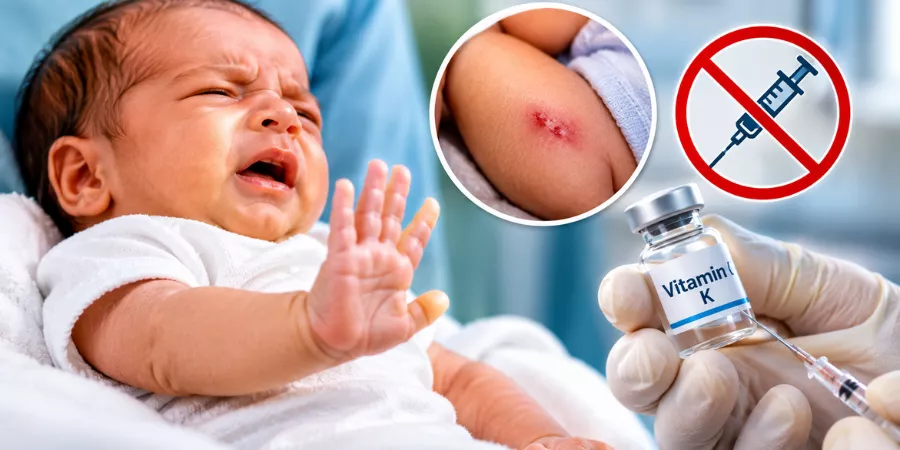
Newborn vitamin K shot refusal is the decision by parents to decline a single intramuscular injection of vitamin K that US hospitals offer shortly after birth. The shot supplies a nutrient that newborns need for blood clotting, and it protects against vitamin K deficiency bleeding (VKDB), a condition that can cause internal bleeding, including bleeding in the brain. The number of babies leaving hospital without the injection has more than doubled in recent years, and bleeding diagnoses in infants have risen over the same period.
Two studies published in JAMA and JAMA Pediatrics on November 5, 2026, document this pattern. Parents who are weighing the decision, and clinicians who are asked to explain it, will find below what the studies measured, why newborns are vulnerable, and what remains uncertain.
How Much Did Vitamin K Shot Rates Decline Between 2017 and 2025?
The JAMA study examined electronic health records for approximately 5.2 million infants born between 2017 and 2025. The share of newborns with no documented intramuscular vitamin K injection rose from 3.1% in 2017 to 6.8% in 2025. An earlier analysis by the same research group had already put the 2024 figure above 5%, which was a 77% increase since 2017. The newest data show that the climb has continued.
The same study found a higher bleeding risk among infants who did not receive the injection. During their first six months, these babies had 288 bleeding cases per 10,000 births, compared with approximately 186 among babies who received vitamin K. Independent reporting on the study describes this as a 47% higher risk of bleeding after adjustment. The gap was largest for intracranial bleeding. Infants who missed the injection had more than twice the adjusted risk of bleeding in or around the brain.
A separate JAMA Pediatrics study, which analysed records of approximately 11 million infants, found that VKDB diagnoses rose from 24 per 100,000 infants in 2017 to 107 per 100,000 in 2025. This is close to a fourfold increase over eight years.
The two studies used different populations and measured different outcomes. The JAMA study counted bleeding of any cause, and many bleeding events in early infancy have no link to vitamin K. The JAMA Pediatrics study focused on vitamin K deficiency and bleeding associated with it. Even so, both point in the same direction.
Independent evidence supports the pattern. A Swedish national registry study of roughly two million infants, published in JAMA Pediatrics in July 2026, reported that babies without the intramuscular injection had 1.52 times the adjusted odds of any bleeding diagnosis and 2.91 times the adjusted odds of intracranial bleeding by six months. Results from two different health systems in two different countries agree, which makes a chance finding less likely.
Refusal is also still accelerating. An analysis of more than one million births by the health data company Truveta, reported by Reuters, found that vitamin K refusals rose by more than 57% between January and June 2026.
Why Do Newborns Need Vitamin K?
Vitamin K is a fat-soluble nutrient that the body uses to make several of the proteins responsible for blood clotting. Without enough of it, bleeding that would normally stop on its own can continue.
Newborns start life with low reserves for three reasons. Only small amounts of vitamin K cross the placenta during pregnancy. Their intestines have not yet developed the bacteria that produce vitamin K. Breast milk also contains only a low concentration of the nutrient. These factors leave infants exposed to vitamin K deficiency bleeding during their first six months.
VKDB appears in three forms. Early-onset bleeding occurs within the first 24 hours. Classical bleeding occurs during the first week. Late-onset bleeding occurs after the first week and can appear up to six months after birth.
Late-onset VKDB deserves the most attention because it can strike babies who looked healthy. According to the US Centers for Disease Control and Prevention (CDC), internal bleeding may occur without obvious warning signs. When the bleeding reaches the brain, the outcome can be permanent neurological damage or death. This is why the recommended prevention is given at birth, before any symptoms exist. One intramuscular injection, usually given in the thigh within hours of delivery, is the standard preventive measure.
Why is Parental Hesitation Raising Concerns Among Doctors?
Clinicians point to misinformation as one driver. Social media posts that question the safety or necessity of routine newborn care reach parents at a moment when they must make several decisions in a short time. Confusion can also come from the way the shot is grouped with other newborn care. The vitamin K injection is not a vaccine. It delivers a nutrient that newborns lack in the quantity they need.
The pattern of refusal matters as well. Reporting on the new studies notes that parents who decline vitamin K are also more likely to decline the hepatitis B vaccine and the antibiotic eye ointment given at birth. Vitamin K refusal may therefore be an early sign of wider hesitation about newborn care, not an isolated choice.
The American Academy of Pediatrics has recommended the injection for all newborns since 1961. That recommendation rests on decades of evidence showing that vitamin K prophylaxis sharply reduces the risk of serious bleeding.
The success of the shot may also be part of the problem. Severe VKDB has become uncommon precisely because nearly every baby received prophylaxis, so many parents and even some clinicians have little direct memory of the disease. A rare outcome is easy to mistake for a small risk. In this article’s editorial assessment, the most useful correction is to explain that the risk is low only because the prevention works.
What Should Parents Know About Vitamin K Deficiency Bleeding?
The CDC advises parents to raise any concerns about newborn vitamin K with their healthcare providers instead of delaying or declining the injection on their own.
Warning signs of VKDB include unexplained bruising, bleeding around the umbilical cord, blood in the stool, vomiting blood, unusual paleness, and excessive sleepiness. The absence of visible symptoms does not rule out internal bleeding, so a baby who looks well is not necessarily safe. Exclusively breastfed infants stay vulnerable, because breast milk alone does not supply enough vitamin K.
Parents who are considering oral vitamin K drops as an alternative should know what the evidence says. The Swedish study found that oral vitamin K was used in fewer than 10% of infants who lacked the injection, and that it was itself associated with higher bleeding odds than the intramuscular route. Current guidance describes oral supplementation as a secondary option that requires strict adherence to a multi-dose schedule and carries a higher risk of late VKDB. One editorial published alongside the JAMA study called for an FDA-regulated oral formulation for families who firmly decline the injection, which indicates that no such product currently exists in the United States. Unregulated drops promoted online have not been shown to protect babies.
Timing also deserves attention. A clinical summary of the Swedish research recommends discussing vitamin K during prenatal visits instead of waiting for the hours after delivery. A parent who has already heard the evidence, and has asked questions in advance, is better placed to make the decision calmly.
What is the Larger Healthcare Concern?
Falling uptake of the vitamin K shot is a preventable public health problem. The studies do not establish why individual families declined the treatment. They do show a consistent association between lower uptake and higher bleeding risk. Because the data are observational, they cannot prove that the missing injection caused every additional bleeding event, although the size of the effect, the agreement between studies, and the long clinical record behind the injection all support that conclusion.
Two further questions follow. Hesitation about one routine newborn intervention may spread to others, and the link with hepatitis B vaccine and eye ointment refusal suggests it already does. Rising VKDB may also be an early signal, since a disease that clinicians once saw rarely is now returning to hospital wards.
For parents, the first step is a conversation with a paediatrician or obstetric care team before the birth. For healthcare providers, explaining how and why preventive treatment works is as important as offering it. The evidence supports one plain message: a condition that has become rare because of prevention has not stopped being a risk.
Author’s Note:
As a writer, I believe conversations about newborn healthcare should begin with clear information rather than fear. Parents naturally want to question medical decisions involving their babies, and they deserve answers that explain both the benefits and potential risks of recommended treatments.
What concerns me about the latest findings is how easily the success of preventive healthcare can become invisible. Vitamin K deficiency bleeding is relatively uncommon, but its consequences can be devastating. When a condition becomes rare because a preventive measure works, it can be tempting to underestimate why that measure exists in the first place.
I believe healthcare professionals have an important responsibility to make these conversations easier for families. Explaining why the vitamin K injection is recommended, addressing concerns without judgement and sharing evidence in accessible language can help parents make informed decisions. In the end, newborn care should be guided by reliable medical evidence, open communication and the best interests of the child.