Winter mornings look calm. The fog sits low over the road, the light comes late, and the air feels cold and clean. In many Indian cities it is neither. Cold weather keeps pollutants close to the ground, so every breath carries more fine particulate matter than it does in summer.
The damage goes beyond a cough or a dry throat. Breathing dirty air for weeks or months can weaken the lungs, make asthma and chronic obstructive pulmonary disease (COPD) harder to control, and push up the risk of heart and respiratory trouble.
A Lancet Planetary Health study tied roughly 33,000 deaths a year in ten Indian cities, about 7.2 per cent of all deaths, to PM2.5 levels above the WHO limit.
Children, older adults, outdoor workers and anyone with a lung condition feel the effects first. Knowing when to stay indoors, how to clean the air at home and which masks actually filter fine particles gives these groups a real way to cut their exposure.
Why Winter Air Pollution Becomes More Dangerous
Pollution exists all year. In winter, the weather stops it from clearing.
The biggest reason is temperature inversion. On a normal day, warm air near the ground rises and takes pollutants up with it. In an inversion, a warm layer settles over the cold air at the surface and acts like a lid. Smoke, exhaust and dust stay low, right at the height where people breathe.
Several other factors add to the problem:
- Stagnant air: When the wind drops, pollutants hang around instead of blowing away.
- Vehicle emissions: Traffic pumps out particulate matter, nitrogen dioxide and other pollutants every day.
- Industrial activity: Factories, power plants and construction sites keep adding to the load.
- Biomass and waste burning: Wood, crop residue, coal and rubbish all release smoke and fine particles.
- Seasonal weather conditions: Poor mixing in the atmosphere lets pollution build up over several days.
Transport, industry, household fuels and seasonal crop burning all feed the same air.
Delhi in November 2025 shows how this plays out. On 11 November the city’s average AQI reached the “severe” category, the first time since December 2024. The Commission for Air Quality Management blamed stagnant winds, stable atmospheric conditions and winter inversion for the spike. The Centre for Research on Energy and Clean Air recorded a November average of 215 µg/m³ for Delhi, double the 107 µg/m³ of October.
One detail in that data surprised me. Stubble burning supplied only about 7 per cent of Delhi’s PM2.5 in November 2025, compared with 20 per cent the year before. The air still stayed bad. AQI readings sat between “very poor” and “severe” for most of October and November. Farm fires play a role, but local sources and the weather can keep winter air dangerous without them.
Fog and smog also get confused. Fog is made of tiny water droplets. Smog contains pollutants. The two often arrive together, so a foggy morning can hide unhealthy air.
An important observation: A clear morning does not prove the air is safe. Fine particles are usually invisible. Check the Air Quality Index (AQI) instead of trusting your eyes or your nose.
What PM2.5 Does to Your Lungs
PM2.5 means fine particulate matter that measures 2.5 micrometres or less across. That is small enough to travel deep into the lungs and reach the air sacs.
Larger dust particles often get caught in the nose and upper airways. Fine particles pass through those defences and settle in lung tissue. Some of their components can also enter the bloodstream.
How badly a person is affected depends on the level of exposure, how long it lasts and the person’s own health.
The common respiratory effects include:
- Airway inflammation: Pollutants irritate the lining of the airways and set off inflammation.
- Coughing and throat irritation: Many people develop a stubborn cough or a scratchy throat.
- Breathlessness: Breathing gets harder, and physical activity makes it worse.
- Worsening asthma: Pollution can trigger symptoms and bring on flare-ups more often.
- COPD complications: People with COPD may see their symptoms get worse and suffer exacerbations.
Long-term exposure to particulate pollution links to lower lung function and a higher risk of serious respiratory and cardiovascular disease.
The Lancet study shows how little extra pollution it takes. Each 10 µg/m³ rise in the two-day average of PM2.5 went with 1.4% higher daily mortality. On days below the Indian air quality standard, the risk per 10 µg/m³ roughly doubled to 2.7%. The WHO daily limit of 15 µg/m³ was exceeded on 99.8 per cent of days, while the Indian limit sits much higher at 60 µg/m³.
The harm also reaches beyond the worst-hit cities. Delhi had the highest share of pollution-linked deaths at 11.5 per cent. Shimla, the cleanest city in the study, still recorded 3.7 per cent.
Who is Most Vulnerable?
Anyone can be affected, but some groups need extra care when the air turns bad:
- Children, whose lungs are still developing.
- Older adults, who often have less respiratory and cardiovascular reserve.
- People with asthma, COPD or another chronic lung condition.
- Individuals with existing heart disease.
- Pregnant women.
- Outdoor workers, traffic personnel and delivery workers who spend long hours on the road.
If you have asthma or COPD, keep following your treatment plan and ask your doctor what extra steps to take during high-pollution weeks.
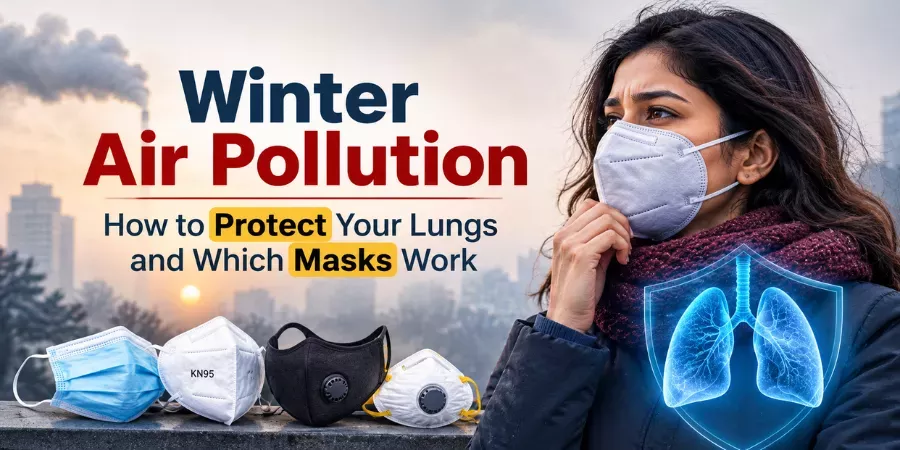
Which Masks Work Against Winter Air Pollution?
Two things decide how well a mask works: the filter and the fit. A mask can use excellent filtering material and still protect poorly if air leaks in around the nose and cheeks.
India’s National Centre for Disease Control (NCDC), which sits under the Ministry of Health and Family Welfare, addresses this in its Health Advisory on Air Pollution. It recommends close-fitting N95 or N99 masks during poor-to-severe pollution episodes (AQI above 200). It also says paper masks, handkerchiefs, scarves and ordinary cloth masks do not work for this purpose.
Here is how the common options compare:
| Mask type | Protection against fine particles | What to know |
| N95 respirator | High when properly fitted | Filters at least 95% of test particles under its certification standard |
| N99 respirator | Higher rated filtration | Filters at least 99% of test particles under its certification standard |
| KN95 respirator | High when compliant and well-fitted | Meets a Chinese filtration standard; manufacturing quality and fit matter |
| Surgical mask | Limited | Loose-fitting and does not provide reliable respiratory protection against fine aerosols |
| Cloth mask | Unreliable | Filtration varies widely and ordinary cloth does not provide dependable PM2.5 protection |
| Scarf or handkerchief | Inadequate | Does not provide a reliable seal or certified particle filtration |
Those filtration percentages come from standard laboratory tests. The US Centers for Disease Control and Prevention (CDC) points out that they do not promise the same level of protection on a real commute.
Beijing offers some real-world evidence. In a randomized crossover trial, 98 patients with coronary heart disease walked the same route through central Beijing twice, once with a highly efficient face mask and once without. With the mask on, they reported fewer symptoms, showed less ST segment depression and had a lower mean arterial pressure (93 against 96 mmHg). A later double-blind trial with 52 healthy adults found something similar: N95 respirators did a good job of cutting PM2.5 exposure. Researchers still urge caution, because these experimental studies were small and looked only at short-term effects.
N95 vs N99 vs KN95: Which Should You Choose?
- N95 respirator: A NIOSH-approved N95 filters at least 95% of airborne test particles under its certification conditions. It is a sensible everyday choice against particulate pollution, as long as it fits.
- N99 respirator: An N99 is certified to filter at least 99% under its testing conditions. It can help when you want stronger filtration, though fit and comfort still decide whether it works.
- KN95 mask: A KN95 follows a Chinese standard that requires at least 95% filtration under its test conditions. Before you buy one, check that it is genuine, well-made and a good fit for your face.
My recommendation: If you commute through polluted areas, pick a genuine N95 or N99 that fits closely, and skip the stylish cloth mask. A mask that seals well and stays on your face beats a higher-rated one that leaves gaps or ends up around your chin.
How to Check Whether Your Mask Fits Properly
Go through this list before you leave the house:
- The mask should cover your nose and mouth and reach under your chin.
- The nose clip should be pressed and shaped around the bridge of your nose.
- You should feel no gaps along the cheeks or the sides.
- Air should flow through the filter material and not leak out around the edges.
- Facial hair along the sealing area can break the seal.
- Replace the respirator as the manufacturer advises, and sooner if it gets damaged, dirty or wet, or if breathing through it becomes hard.
A respirator should feel snug without becoming painful. If you have a breathing or heart condition, ask your doctor whether wearing one is safe for you.
What Masks Cannot Do: Understanding Their Limitations
Even a good N95 or N99 has limits. These masks catch airborne particles, including PM2.5. They do not stop every harmful substance in the air.
They do not automatically protect against:
- Carbon monoxide.
- Nitrogen dioxide.
- Sulphur dioxide.
- Ozone.
- Harmful gases and chemical vapours.
The CDC and its National Institute for Occupational Safety and Health (NIOSH) clearly separate particulate respirators from gear designed for gases and vapours.
Outdoor pollution is a mixture, and an N95 deals with only part of it. It lowers your exposure to fine particles. The gases pass straight through.
So, treat a mask as one piece of a wider plan to protect your lungs. It does not give you permission to spend hours in heavily polluted air.
How to Protect Your Lungs from Air Pollution During Winter
Cutting your exposure usually does more than wearing a mask. The NCDC advisory lists several practical steps for people living with poor-to-severe air.
These habits are worth adding to your daily routine.
- Check AQI Before Planning Outdoor Activities
The Air Quality Index (AQI) converts pollution readings into categories that show the health risk.
India’s CPCB sorts air quality into six categories:
- Good: 0–50
- Satisfactory: 51–100
- Moderately polluted: 101–200
- Poor: 201–300
- Very Poor: 301–400
- Severe: 401–500
You can check your city’s AQI on the CPCB website or in its SAMEER mobile app. Once the level reaches poor or worse, think again about outdoor exercise, long commutes and any trip you can skip.
- Choose the Right Time to Ventilate Your Home
Leaving the windows open all day does not always help in winter.
On poor-to-severe AQI days, the NCDC advises keeping external doors and windows shut in the morning and late evening. If the house needs fresh air, it suggests the afternoon, between noon and 4 pm, and it asks you to check the local air quality first.
A few other steps help too:
- Keep doors and windows closed when outdoor pollution is high.
- Switch your car’s air conditioning to recirculation in polluted conditions.
- Do not burn wood, coal or other solid fuels indoors.
- Go easy on incense sticks, mosquito coils and tobacco smoke in closed rooms.
- Consider an Air Purifier for Indoor Protection
A purifier with a suitable HEPA filter can reduce the particulate matter floating around a room.
Before you buy one, check these points:
- The size of the room and the purifier’s clean air delivery rate (CADR).
- Whether the device uses a genuine, properly rated particle filter.
- What replacement filters cost and how much upkeep the unit needs.
- How loud it is, and whether you can leave it running most of the day.
The US Environmental Protection Agency (EPA) recommends portable air cleaners that match the room size, along with high-efficiency HVAC filters, to cut indoor particle exposure. It also advises against devices that produce ozone.
A purifier cannot remove every indoor pollutant. Controlling the sources of smoke, dust and chemical fumes still counts.
- Avoid Outdoor Exercise During High-Pollution Periods
Exercise makes you breathe faster and deeper, so you take in more polluted air.
When AQI is high:
- Move outdoor workouts indoors.
- Stay away from busy roads when you jog or cycle.
- Reschedule morning and evening walks while pollution stays high.
- Cut back on strenuous activity.
- Keep children from playing near heavy traffic.
People with asthma, COPD and heart conditions need to follow this advice most closely.
- Keep Your Respiratory Health Under Observation
Watch for a cough that will not go away, wheezing, a sore throat, breathlessness or tightness in the chest.
People with existing respiratory conditions should:
- Follow their prescribed medication and treatment plans.
- Keep their medication within easy reach.
- Avoid strenuous activity when pollution levels are high.
- Seek medical advice if symptoms get worse.
Do not shrug off serious breathing trouble or chest pain as ordinary winter discomfort. Get urgent medical help if either one appears.
When Should You Seek Medical Attention?
Some symptoms ease once you leave the polluted area. Symptoms that last or keep getting worse need a doctor.
Consult a healthcare professional if you have:
- A cough or wheeze that persists.
- Repeated bouts of breathlessness.
- Tightness or discomfort in the chest.
- Asthma or COPD symptoms that are getting worse.
- Unusual tiredness, or trouble with routine tasks.
Severe breathlessness, significant chest pain or a sudden struggle to breathe needs urgent medical evaluation.
Children, older adults and people with existing respiratory or heart conditions should take extra care whenever a pollution episode drags on.
Conclusion
No single step solves winter air pollution. A snug N95 or N99 can lower your exposure to fine particles. It cannot filter harmful gases, and it cannot cancel out long hours outdoors.
The better approach uses several habits together. Check the AQI, adjust your outdoor plans, clean the air indoors, cut down household smoke and wear the right respirator when you go out.
One habit is worth remembering: protect your lungs before you leave home. Look at the day’s air quality, choose a quieter route or move your workout indoors. Small choices like these can noticeably lower what you breathe in each day.
Clean air is a public health responsibility, and large-scale pollution control remains essential. Until that happens, informed daily decisions can still cut some of your risk.