The United States has expanded health insurance coverage significantly over the past decade, yet having an insurance card does not always mean having timely, affordable healthcare.
In 2025, 26.7 million Americans, or 7.9% of the population, were uninsured for the entire year, according to the U.S. Census Bureau. The figure was statistically unchanged from 2024. At the same time, millions of insured Americans still face high deductibles, medical debt, limited provider networks or long waits for care.
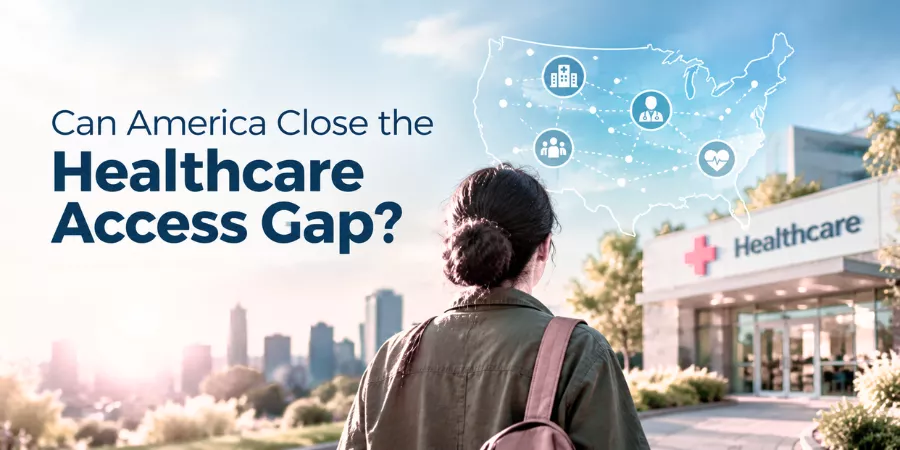
That leaves America with a more complicated question than how to expand coverage: Can the country close the healthcare access gap itself?
What is the Healthcare Access Gap in America?
The healthcare access gap describes the difference between having healthcare theoretically available and being able to obtain appropriate care when it is needed.
Insurance is one part of the equation. Cost, location, provider availability, transportation, appointment delays, language barriers and the availability of culturally appropriate care can all determine whether someone actually receives treatment.
The CDC reported that 6% of U.S. adults failed to obtain needed medical care because of cost in 2025. In 2024, 88.6% of adults had a usual place to go for medical care, meaning a significant minority did not have a regular source of care.
The problem therefore exists at several levels:
- Coverage: People without health insurance may delay or avoid treatment.
- Affordability: Insurance can still leave patients with substantial out-of-pocket expenses.
- Availability: Some communities simply do not have enough doctors or other healthcare professionals.
- Geography: Rural communities can face particularly severe shortages.
- Disparities: Access varies across racial, ethnic and socioeconomic groups.
Why Does Health Insurance Alone Not Solve the Problem?
Being insured does not guarantee affordable access to medical care.
The Commonwealth Fund’s 2024 Biennial Health Insurance Survey found that 23% of working-age adults were underinsured despite having coverage throughout the year. Among underinsured adults, 57% said they avoided needed healthcare because of cost.
This creates an important distinction between health insurance coverage and meaningful healthcare access.
A patient may have insurance but postpone seeing a specialist because of a deductible. Another may struggle to find a physician who accepts the plan. Someone living in a rural community may technically have coverage while facing a long drive to the nearest specialist.
Closing the healthcare access gap requires addressing those barriers together.
How Big is America’s Primary Care Shortage?
The shortage of healthcare professionals is one of the biggest obstacles to improving access.
HRSA reported 8,466 designated primary care Health Professional Shortage Areas as of December 2025, representing about 92 million residents, or roughly 27% of the U.S. population. About 63% of these designated shortage areas were rural. HRSA estimated that 15,628 additional physicians would be needed to eliminate the existing primary care shortage designations.
The workforce challenge could become larger. HRSA projects a shortage of about 70,610 full-time-equivalent primary care physicians by 2038.
This makes expanding the healthcare workforce central to any long-term effort to improve healthcare access in America.
Which Communities Face the Largest Healthcare Access Barriers?
Healthcare access is not evenly distributed across the country.
Racial and ethnic disparities remain visible in insurance coverage. KFF found that in 2024, Hispanic people under age 65 had an uninsured rate of 18.4%, while the rate was 10.1% for Black people and 6.8% for White people. American Indian and Alaska Native people had an uninsured rate of 18.9%.
Geography creates another divide. Rural communities often have fewer primary care providers, hospitals and specialists, making distance itself a healthcare barrier.
The result is a system where two Americans with similar medical needs can experience very different levels of access depending on where they live, their income, their insurance and the availability of providers.
Can Technology Help Close the Healthcare Access Gap?
Technology can remove some barriers, although it cannot solve the entire problem.
Telehealth can connect patients with clinicians without requiring every appointment to involve a long journey. Digital scheduling, remote monitoring and electronic health records can also make parts of the healthcare system easier to navigate.
Artificial intelligence may eventually help healthcare organizations manage administrative work, identify patients who need follow-up and support clinicians with information. But technology depends on infrastructure, broadband access, digital literacy and clinical availability.
A virtual appointment also cannot replace every physical examination, diagnostic procedure or emergency service.
Technology is therefore best viewed as one part of a broader healthcare access strategy.
What Would It Take to Close the Healthcare Access Gap?
There is no single policy that can eliminate the gap. A more practical approach would address several problems simultaneously.
- Expand the healthcare workforce. Medical training, residency capacity, incentives and programs that encourage clinicians to work in underserved communities can help address provider shortages. HRSA already uses shortage designations to direct workforce resources toward communities with limited access.
- Make primary care easier to reach. Stronger primary care networks can give patients a consistent place to receive preventive care, manage chronic conditions and obtain referrals.
- Reduce financial barriers. Lower premiums alone may not be enough if deductibles and other out-of-pocket costs remain unaffordable.
- Strengthen rural healthcare. Rural hospitals, clinics and community health centers need sustainable staffing and financing models that reflect the challenges of serving smaller and more dispersed populations.
- Use technology where it actually helps. Telehealth and digital healthcare tools can extend the reach of existing professionals, particularly when distance is the main barrier.
- Simplify enrollment and navigation. Healthcare programs can become difficult to use when eligibility rules, renewals and paperwork are complicated. The CDC has identified affordability and enrollment complexity among important reasons people remain uninsured.
What is Changing in U.S. Healthcare Coverage in 2026?
The healthcare access debate is also entering a period of policy change.
The 2025 federal reconciliation law made substantial changes to Medicaid and Affordable Care Act Marketplace coverage. The Congressional Budget Office estimates cited by KFF project that the law, combined with the expiration of enhanced ACA premium tax credits, could result in more than 14 million additional uninsured people in 2034 compared with a scenario in which the enhanced credits remained in place.
CMS has also issued rules implementing a new Medicaid community-engagement requirement for certain adults. States generally must implement the requirement by January 1, 2027.
These changes make coverage policy an important part of the healthcare access discussion, while their practical effects will depend on implementation and how individuals respond to the changing rules.
Conclusion
America can reduce the healthcare access gap, but closing it requires more than increasing the number of insured people.
The country has already demonstrated that coverage can expand. The remaining challenge is making healthcare usable: a doctor who is close enough to reach, an appointment that is available, a treatment a patient can afford and a system that people can navigate without unnecessary barriers.
The latest numbers show both progress and unfinished work. The uninsured rate remains below the levels seen several years ago, yet 26.7 million people were uninsured in 2025, while millions more had coverage that still did not make healthcare affordable.
The future of American healthcare access will therefore depend on how effectively the country connects coverage, affordability, workforce capacity and actual availability of care.
That is where the healthcare access gap will ultimately be measured, not by how many people have an insurance card, but by how many can get the care they need when they need it.