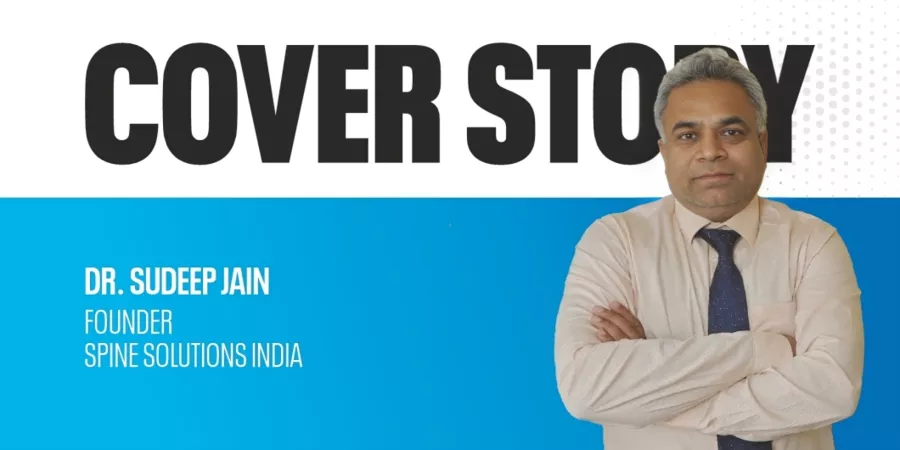
There is a particular kind of silence that falls in an outpatient department when a patient hears the word spine. It is not the quiet of calm acceptance. It is a pause filled with stories heard in waiting rooms and family WhatsApp groups, about paralysis, chronic pain and surgeries that were forever postponed out of fear. In a country as vast and densely populated as India, that silence has repeated itself in millions of consulting rooms over the past few decades.
For more than twenty-five years, Dr. Sudeep Jain has chosen to stand in the middle of that silence. As a spine surgeon and the founder of Spine Solutions India, he has spent his working life inviting patients to replace fear with informed choice. The journey that led him there did not begin in a plush private hospital. It began in a crowded government institution in New Delhi, with a single question that would change the direction of his career.
Around 2002, during his postgraduate years at Ram Manohar Lohia Hospital and Lady Hardinge Medical College, the orthopaedic outpatient department and emergency were flooded with patients suffering from spinal ailments. Despite the sheer numbers, there was only one senior consultant who regularly ran the spine clinic and the spine operating theater. He was not only a senior professor but also the head of the department, carrying the full weight of clinical and administrative responsibilities. The waiting room kept overflowing. The waiting list for surgery kept stretching further into the future.
One day, that professor called the young trainee into his room and made an offer that was equal parts challenge and opportunity. He asked whether the postgraduate resident could study spine texts intensively for a few months, return with real knowledge and take charge of the spine clinic and the long surgical waiting list. The professor promised that he would always remain available to teach, to guide and to supervise. What he could not do any longer was spend entire days between the clinic and the operating room while balancing the demands of a large department.
The closing line of that conversation stayed with Dr. Jain for life. As he recalls it, his teacher told him that if he took on the responsibility, he could consider himself passed in his final postgraduate examination, regardless of how he performed in the formal tests. For a young doctor, it was a striking blend of trust and pressure. It meant that competence would not be measured only by written answers and viva questions. It would be measured by whether he could carry a clinic on his shoulders and deliver safe, effective spine surgery to patients who had already waited too long.
It was in that moment that the contours of his future began to sharpen. What started as an invitation to help clear an ever-expanding waiting list became a defining commitment. In the years that followed, Dr. Jain would move from that crowded clinic to the national stage at the All India Institute of Medical Sciences, to international fellowships and eventually to his own centres in Delhi and Kanpur. The thread that runs through the story is simple. When the spine of a health system starts to falter under volume and complexity, someone has to step forward and hold it straight.
Today, that same resident who once stood in an overwhelmed government clinic is recognised among the Top 10 Prominent Spine Surgeons 2025 by The Industry Insights magazine. The road between those two points passes through intense responsibility, global exposure, indigenous innovation and a deep belief that advanced spine care must remain within reach of ordinary families.
The Question That Changed His Life
That first conversation in RML and LHMC did more than assign a task. It forced a young doctor to decide whether he would treat spine surgery as one subject among many or as the central axis of his professional life.
He chose the harder path. Dr. Jain immersed himself in spine literature, case discussions and operating room experience. The promise of guidance from his professor was real, yet the day-to-day responsibility of running the spine clinic rested on him. He began to see not only the pathology on images but also the social context of each case. Many patients had already lived with severe pain and disability for years. Some had travelled long distances with limited means. For them, a slot on the waiting list was more than a date in a register. It was a chance to reclaim mobility and dignity.
That early exposure to volume and complexity taught him two lessons that would echo through the rest of his career. First, spine surgery demands a rare mix of technical skill, stamina and maturity. Second, access to that level of care cannot be reserved only for those who can pay the most. Those ideas would later resurface in his work in public hospitals, in his role in building government corporate partnerships and in the way he designed Spine Solutions India as a high volume yet socially conscious practice.
The AIIMS Years
After completing his postgraduate training, Dr. Jain joined the All India Institute of Medical Sciences in New Delhi as a senior resident and registrar. The move placed him at the heart of a national referral centre for complex spine and scoliosis surgery.
At AIIMS, the spine and scoliosis clinic and operating theater were led by a senior director professor who is widely regarded as one of the doyens of scoliosis surgery in India and beyond. During that period, the department was facing a shortage of residents, and the senior professor himself was dealing with health issues. The practical outcome was that the burden of running a tertiary level spine and scoliosis unit, serving patients from across the country, rested on the shoulders of Dr. Jain and one other resident.
The unit performed among the highest volumes of complex scoliosis surgeries in India and ranked alongside major centres worldwide. In that intense environment, Dr. Jain reached what he describes as the pinnacle of his spine and scoliosis training during residency. AIIMS became, in his words, a “mahakumbh of spine and scoliosis surgery” where he learned to manage deformities that would intimidate even experienced surgeons.
Those years were not only about numbers. They also sharpened his discipline. Long days in the clinic and operating room demanded precision, yet they also called for empathy. Many of the children and young adults who came to the unit carried visible deformities and invisible emotional burdens. Working with them reinforced his belief that spine surgery, at its best, restores more than alignment. It restores confidence.
Wings Across Borders
AIIMS gave Dr. Jain what he calls “wings to fly”. After completing his residency there, he went on to secure three international fellowships back to back. Each fellowship addressed a different dimension of spine surgery and added a new layer to his expertise.
The first stop was Seoul in South Korea, at a scoliosis research institute that is one of the highest volume centres for neuromuscular scoliosis in the world. There he gained humongous exposure to conditions such as Duchenne muscular dystrophy, spinal muscular atrophy and cerebral palsy. Managing these cases demanded not only surgical skill but also an understanding of how systemic neuromuscular disorders interact with spinal deformity and overall quality of life.
He then moved to Izmir in Turkey, where he trained under a world renowned neurosurgeon in spinal neurosurgery. Textbooks and scientific publications written by this mentor form the basis of residency programs for young neurosurgeons around the world. The fellowship refined Dr. Jain’s sense of microsurgical technique and deepened his respect for the delicate relationship between the spine and the nervous system.
The third fellowship brought him to Singapore, to an institute that pioneered minimally invasive keyhole endoscopic spine surgeries. The centre is a progenitor of many minimally invasive spine procedures and a torchbearer in endoscopic spine surgery for the rest of the world. In Singapore, he saw how smaller incisions, less muscle dissection and advanced optics could transform recovery experiences for patients, without compromising on the quality of decompression or stabilization.
Across these fellowships, Dr. Jain remained actively involved in spine research. He contributed scientific papers, presentations and research articles to international peer reviewed journals with high impact factors. He participated in cadaveric research, wrote chapters in spine textbooks read by young aspiring surgeons and served as an invited reviewer on the editorial boards of several international spine journals. These experiences placed him at the intersection of clinical practice and academic innovation, a position he continues to occupy.
Back Home to Serve
After completing his international training, Dr. Jain returned to India with a clear sense of purpose. He joined a government hospital in Delhi as a spine specialist and spent three years there providing free, state of the art spine care to some of the poorest patients from the city’s slums.
In that environment, he was constantly reminded that technological sophistication only matters when it reaches real people. The patients he treated often had limited access to basic amenities. Many had never imagined that advanced spine surgery could be available to them without crippling financial burden. For Dr. Jain, these years underscored the responsibility that comes with specialised training. Knowledge gained in the most advanced centres of the world had to translate into accessible care on the ground.
After this public sector stint, he transitioned into private practice, first with Fortis Hospital and then with Max Healthcare in Delhi. These roles allowed him to apply his skills in high end corporate environments while still holding on to the ethos of service he had built in government institutions.
Eventually, he took the entrepreneurial step of opening his own centres under the name Spine Solutions India. The first centre was established in Naraina Vihar in West Delhi, followed by a second in Kanpur in Uttar Pradesh. Today, SSI runs as a busy, high-volume practice that attracts patients from across the region. Even within this private setup, Dr. Jain continues to give back to society by performing many free spine surgeries under public schemes such as the Ayushman card and the Pradhan Mantri Jan Arogya Yojana.
Minimally Invasive Before It Was Fashionable
Having trained in some of the most pioneering institutes for minimally invasive spine surgery and scoliosis surgery in India and abroad, Dr. Jain did not treat minimally invasive techniques as a passing trend. He embraced them early and built a long track record with them.
He began performing minimally invasive spine surgeries in Delhi at least fifteen years ago, at a time when very few surgeons in the city were doing so. In those early years, he became one of the highest volume surgeons in India using Medtronic minimally invasive MIS spine instrumentation systems and implants.
For patients, the difference is not abstract. Minimally invasive procedures can mean shorter incisions, less muscle disruption, lower blood loss and faster recovery. For a surgeon, they demand meticulous planning and a precise understanding of three-dimensional anatomy, since much of the work happens through narrow corridors. For Dr. Jain, minimally invasive spine surgery became a way to align his technical ambitions with his desire to reduce suffering as much as possible.
In his practice, minimally invasive approaches are not limited to a few select cases. They are an integral part of how he thinks about decompression, stabilization and deformity correction, always balancing what is technically feasible with what is safest and most beneficial for the person on the operating table.
Make In India, Operate for The World
More than ten years ago, around 2014 to 2015, Dr. Jain added another dimension to his work. Under the larger national movement of Make in India, he joined PITKAR, one of the oldest and most prominent orthopaedic and neurosurgical instrumentation and implant companies in the country, as a chief scientist.
At PITKAR, he helped develop the first indigenous minimally invasive MIS spine system of India. The system has its own unique design that remains patented by the company. It emerged from the combination of hands-on surgical experience and engineering design, tailored to the anatomical realities and practical needs of Indian patients and surgeons.
The impact did not stop there. The success of this system encouraged other orthopaedic and neurosurgical implant companies in India to enter the MIS space. Today, Indian implant manufacturers are active in providing very high quality, significantly more affordable minimally invasive spine implants to the domestic population. They are also exporting to a large number of countries, including continued manufacturing of Dr. Jain’s initial design by PITKAR.
This journey from importing advanced systems to designing indigenous ones reflects a broader shift in Indian healthcare. It also highlights Dr. Jain’s belief that innovation must eventually reduce costs and expand access. For him, Make in India is not only a policy slogan. It is a lived reality in the screws, rods and systems that hold reconstructed spines in place.
Stories that Stay with Him
After doing thousands and thousands of spine surgeries over more than twenty five years, Dr. Jain can recall hundreds of patient stories that left a mark on him. A handful illustrate how deeply spine care intersects with sport, public life and everyday households.
One such story is close to home. Manika Batra, the Indian national table tennis ace and a neighbour of Dr. Jain in Naraina Vihar in West Delhi, developed a neck sprain and strain during her trials just before the Asian Championships. She received neurotherapy at his centre and went on not only to participate but to win the Championship in 2024. She is both an Arjuna Awardee and a Major Dhyan Chand Khel Ratna Awardee.
Another story is that of Sandeep Singh, also known as Flicker Singh for his drag flick in hockey. The former national team captain was accidentally shot in the back while travelling by train for the Hockey World Cup and became paralysed in both legs. The film Soorma, starring Diljit Dosanjh, Taapsee Pannu and Angad Bedi, produced and directed by Chitrangda Singh and Shaad Ali, is based on his life.
In 2007, during Dr. Jain’s tenure at AIIMS in Delhi, Sandeep Singh briefly received regenerative medicine, neurotherapy and stem cell therapy for neuronal regeneration under his care. He returned to full recovery, scored the winning goal for India in the 2009 Commonwealth Championship in London and went on to receive the Arjuna Award from the President of India in 2010.
Dr. Jain also recalls treating late Shri Oscar Fernandes, who served as Union Minister of Road Transport and Highways and Union Minister of Labour and Employment in a previous government led by Dr. Manmohan Singh. Oscar Fernandes underwent successful spine surgery at AIIMS Delhi in 2008 during Dr. Jain’s tenure, when he was Minister of State with independent charge in the Ministry of Labour and Employment.
Another case involved late Shri Om Puri, Padma Shri awardee, two time National Film Award recipient and two-time Filmfare Award recipient. He underwent successful cervical spine surgery for ossification of the posterior longitudinal ligament at AIIMS Delhi in 2009 during Dr. Jain’s tenure and went on to receive a lifetime achievement award that same year.
More recently, the current Speaker of the Uttar Pradesh Legislative Assembly, Shri Satish Mahana, has been under Dr. Jain’s care at his Kanpur centre for cervical spine issues. He has been advised cervical disc replacement surgery and is expected to undergo the procedure when his schedule allows.
These names point to one reality. Spine disease does not respect professions or status. It can affect elite athletes, politicians, artists and ordinary citizens with equal force. What matters is whether they find their way to a team that can help them stand tall again.
A Field Poised to Grow
Looking ahead, Dr. Jain believes that spine surgery is one of the most promising careers for young orthopaedic surgeons and neurosurgeons. The reasons are structural, not anecdotal.
India’s vast population and the increasing number of international patients travelling to the country for more affordable spine surgeries both drive demand. On the supply side, there is rapid expansion of medical infrastructure in both public and private sectors. New medical colleges and AIIMS campuses are opening. Big corporate hospitals are growing, supported by funding from investors and promoters, initial public offerings and foreign direct investment.
Cutting edge technology has become available at levels that are at par with or sometimes even ahead of the West. Local innovations under the Make in India ideology and easier, cheaper loans for Indian medical equipment companies under MSME policies have boosted the entire health sector, including spine surgery. Any top end technology developed anywhere in the world is now very readily accessible in many parts of India.
The use of these advanced methods in spine surgery has improved patient results and outcomes exponentially and has reduced surgical failures and complications drastically. In turn, patient confidence and willingness to undergo spine surgery when needed has grown significantly. The phobia, fear, negativity and myths surrounding spine surgery risks have reduced markedly.
Dr. Jain is convinced that young spine surgeons in the coming years will witness more and more very high-volume spine surgery centres across India. They will inherit a field in which fear has steadily been replaced by trust, and in which Indian patients can expect world class spine care close to home.
From that early conversation in a government hospital corridor to the status of a leading spine surgeon and founder of Spine Solutions India, his story traces how dedication, innovation and social commitment can straighten more than a spinal column. They can help straighten the arc of access itself, so that advanced spine surgery becomes not a privilege but a realistic option for families across the country.