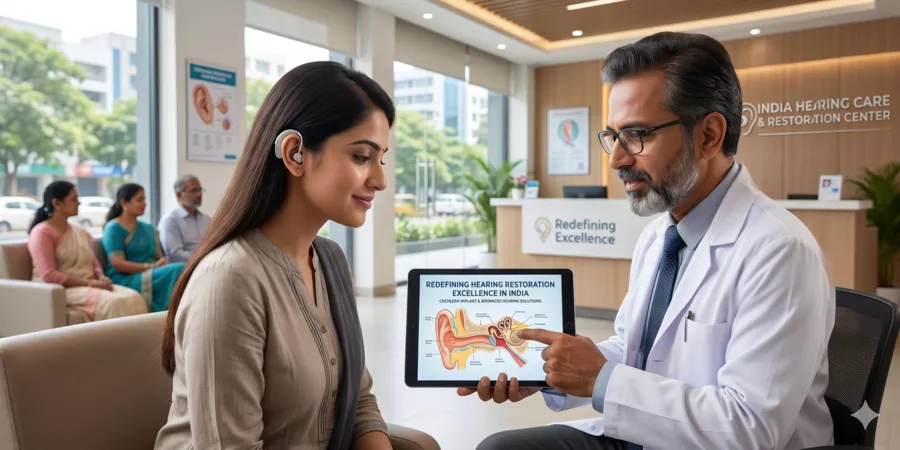
Approximately 63 million Indians live with significant auditory impairment — yet fewer than 2% have access to adequate hearing care. That gap between need and treatment is closing, and the forces driving that change are reshaping what hearing restoration means in the world’s most populous nation.
Why Hearing Restoration in India Is at a Critical Turning Point
For decades, hearing loss in India was treated as an inevitable consequence of aging or illness — something to be managed quietly rather than treated decisively. That perception is rapidly being dismantled.
A new generation of audiologists, ENT surgeons, and rehabilitation specialists is emerging with training from globally recognised institutions, bringing world-class diagnostic and surgical capabilities to Indian hospitals and clinics. Combined with government-backed initiatives such as the National Programme for Prevention and Control of Deafness (NPPCD), the ecosystem supporting hearing restoration in India has never been stronger.
The shift is not merely clinical — it is cultural. Patients are arriving earlier, asking better questions, and demanding outcomes that go beyond basic amplification. This demand is pushing providers to raise the bar on every dimension of care.
The Technology Transforming How India Treats Hearing Loss
The introduction of advanced cochlear implant systems, bone-anchored hearing aids (BAHA), and AI-integrated audiological assessments has fundamentally altered treatment possibilities for patients across age groups.
Cochlear implants, once accessible only in metro centres at prohibitive costs, are now being offered through government subsidy programmes and insurance-linked schemes in Tier 2 cities. The Assistive Devices Scheme under the ADIP programme has enabled thousands of economically disadvantaged patients to receive implants that were previously out of reach.
Simultaneously, digital hearing aids embedded with machine learning algorithms now adapt to a user’s acoustic environment in real time. These devices differentiate between background noise and speech with remarkable precision, delivering a listening experience that far surpasses conventional analogue aids. For patients with moderate to severe sensorineural hearing loss, this technology represents not just restoration but genuine life transformation.
How Specialists Are Raising the Standard of Audiological Care
Excellence in hearing restoration is never the result of technology alone. It is built on the clinical judgment, surgical precision, and patient empathy of the specialists delivering care.
Leading otolaryngologists and cochlear implant surgeons across India are now operating within multidisciplinary teams that include speech-language pathologists, audiological therapists, and paediatric developmental experts. This team-based model ensures that restoration does not end in the operating theatre — it continues through structured rehabilitation programmes tailored to each patient’s lifestyle and communication goals.
- Pre-surgical counselling ensures patients and families understand realistic outcomes before committing to intervention.
- Post-implantation mapping sessions fine-tune device programming as the auditory nerve adapts over weeks and months.
- Long-term follow-up protocols track speech perception progress and device performance across years, not just months.
This continuum-of-care philosophy is what separates genuine excellence from transactional treatment.
Paediatric Hearing Restoration: India’s Most Urgent Priority
Of all patient groups, children with congenital hearing loss stand to gain the most from early, precise intervention. Research consistently demonstrates that cochlear implantation before 18 months of age delivers dramatically superior speech and language outcomes compared to later intervention.
India’s Universal Newborn Hearing Screening (UNHS) programme, though still unevenly implemented, is creating the infrastructure for earlier identification. Hospitals in states including Maharashtra, Tamil Nadu, and Karnataka are now integrating automated auditory brainstem response (AABR) testing into standard neonatal care — catching hearing impairments within days of birth.
Early identification paired with swift surgical referral is the single most powerful lever for transforming a child’s developmental trajectory. Specialists championing this cause are not simply performing procedures — they are preserving futures.
The Role of Rehabilitation in Completing the Restoration Journey
A cochlear implant activated without rigorous auditory rehabilitation is a tool handed to someone who has never been shown how to use it. Rehabilitation is not supplementary to hearing restoration — it is the process through which restoration becomes real.
India’s top hearing restoration centres now offer structured auditory-verbal therapy (AVT) programmes that guide patients through listening hierarchies — from detecting sound, to discriminating between sounds, to identifying speech in quiet, and ultimately comprehending conversation in complex environments. For adults who have experienced prolonged hearing deprivation, this retraining of the auditory cortex can take 12 to 24 months of consistent practice.
The clinicians delivering this rehabilitation represent some of the most specialised professionals in the Indian healthcare system, combining expertise in linguistics, neurology, and behavioural therapy to deliver measurable, documented outcomes for every patient in their care.
Building an India Where No Hearing Loss Goes Untreated
The vision driving the most committed practitioners in this field extends well beyond individual patient outcomes. It encompasses a future where geography, income, or awareness no longer determine whether a person with hearing loss receives the care they deserve.
Tele-audiology platforms are extending diagnostic services to rural districts. Training partnerships between Indian medical institutions and international cochlear implant manufacturers are building local clinical capacity at scale. And a growing body of Indian-led research is generating data that reflects the specific audiological, linguistic, and cultural contexts of the subcontinent — moving the field beyond dependence on Western clinical models.
India is not merely adopting global standards in hearing restoration. It is beginning to set them.
The specialists, institutions, and innovators redefining this field share one conviction: that the ability to hear is not a privilege to be rationed. It is a human right to be restored — with excellence, with urgency, and without compromise.