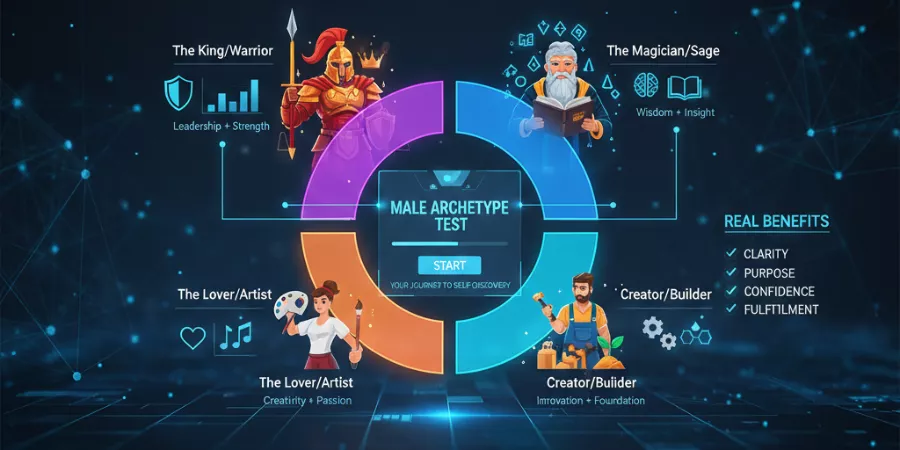
A male archetype test measures recurring patterns of behavior, motivation, and identity, often called Masculine Archetypes, that men use to make sense of life. The idea traces back to Jungian psychology and Jungian archetypes, which described universal character templates that appear across cultures and time. Modern archetype frameworks adapt those templates into practical profiles, which is why a Masculine Archetypes Test can support self-understanding, relationships, leadership, and personal growth.
Let us break it down into what an archetype test is, common archetypes used for men, how tests work, what results mean, how to use them in daily life, and important cautions to keep in mind.
What is a Male Archetype Test?
A Male Archetype Test is a Self-discovery tool that helps you understand what kind of masculine energy you naturally lead with, using Masculine Archetypes as the framework.
Instead of calling you introvert or extrovert, a Masculine Archetypes Test describes you through archetypes, which are personality patterns that show up in how you think, lead, love, react, and handle pressure.
Common Male Archetypes Explained
Here are core archetypes you will meet in most frameworks, and these Masculine Archetypes are kept short, plain, and practical.
- King Archetype = Leadership through presence. The King protects, brings order, and creates legacy. He steers with steady vision and assumes responsibility.
- Warrior Archetype = Discipline serves as the foundation for taking action. The Warrior executes his duties under pressure while establishing boundaries to complete his challenging assignments. The situation proves beneficial for him during both training sessions and competitive events.
- Magician Archetype = The process of transformation occurs through the acquisition of knowledge. The Magician uses three skills to observe patterns and create new knowledge and teach others about transformation. He uses his knowledge to create advantages.
- Lover Archetype = Connection through sensation. The Lover brings warmth, curiosity, and closeness. He creates rituals that deepen presence.
- Ruler Archetype = The Ruler establishes order by controlling both resources and roles while managing all operational procedures. The Ruler establishes order by controlling both resources and roles while managing all operational procedures of the organization.
- Explorer Archetype = Discovery through risk. The Explorer tests limits, seeks novelty, and resets context with bold moves.
- Caregiver Archetype = The service provides help to those in need through its support programs. The caregiver provides his services to assist others while demonstrating both patience and humility.
- Rebel Archetype = An innovative, fascinating prospect that would upset traditional positions or views along a solid line of coherence among disciplines in an academy, the Rebel should be empowered.
A single person will carry mixtures. Use dominant energy to guide major choices and secondary energy to design balance.
How a Male Archetype Test Works
Most tests use scenario questions and scaled responses, and a good Masculine Archetypes Test turns those answers into clear patterns. The process consists of these standard procedures:
- The study requires participants to complete basic tasks which measure their daily energy levels and their energy sources.
- The assessment includes situation-based tests which measure your reactions to pressure situations and your interactions with authority figures and your intimate relationships.
- The value statements show what you protect and what you choose to pursue and what you refuse to compromise.
- The scoring algorithm calculates answer weights to determine archetypal patterns which test takers show.
- The profile presents information about strengths and blind spots together with practical exercises.
High quality tests include reflection prompts and suggested experiments. The most effective assessment method combines self-report information with third party evaluations to decrease bias.
What a Male Archetype Test Reveals About You
The test reveals three core things:
- Dominant energy you bring into life and work. This explains your default approach.
- Secondary energy that helps you adapt across contexts. This explains flexibility and tradeoffs.
- Shadow patterns that surface under stress. These reveal where growth matters most.
A practical example: The primary Warrior and secondary Magician combination creates a character who executes his tasks with perfect accuracy. The shadow manifests itself through two behaviors which include impatience and emotional avoidance of situations that require him to be vulnerable. The path forward becomes clear after you develop this understanding, because the warrior’s strength is powerful when it is paired with emotional awareness because you should maintain your existing strengths through your current work while you develop new skills through gradual progress.
Male Archetype Test Benefits for Self Growth
Archetype work propels development growth through several direct mechanisms.
- It helps in getting clear about the next skills one needs to develop.
- It uncovers the emotional triggers so that the emotional reactions become predictable and manageable.
- It offers a framework for the daily workout that is closely linked with real results.
- It lessens shame by changing the behavior explanation to energy patterns rather than moral failure.
- It enhances decision making as choices tend to be in line with the predominant impulses.
One’s development becomes a function of practice. Identify one of your least developed archetypes, do a four, week micro, experiment with it, and then check how your interpersonal relationships and work performance have changed.
Male Archetype Test for Relationships and Communication
Archetype awareness changes how partners talk.
When two people map their archetypal tendencies they gain simple translation tools. For example:
- A partner with Kingenergy values responsibility and vision. They respond well to partnership around long-term planning.
- A partner with Loverenergy needs presence, affection, and shared sensory experiences. They respond well to rituals of connection.
- When conflict flares, naming the archetypal pattern turns emotion into a coaching moment rather than a blame cycle.
Use the profile as an activation guide. After a test, pick three relationship behaviors to practice for three weeks and ask for feedback.
Why Men Feel Drawn to Archetype Tests and Masculine Archetypes
The immediate experience of archetypes shows their practical value. The reasons men select these archetypes include:
- The first reason people choose this path provides instant understanding without the need for medical terminology.
- The second reason people choose this path provides specific actions which help them develop instead of requiring a prolonged assessment process.
- The third reason people choose this path provides a special vocabulary which helps users handle their emotional work without feeling dangerous.
- The fourth reason people choose this path enables men to show their cultural identity through their role and purpose.
- The fifth reason people choose this path provides a method to show their internal changes through new visible behaviors.
Leaders who succeed in their roles create partnerships and develop their presence by using archetypes as a bridge between their personal development and their professional success.
What Your Male Archetype Says About Your Personality
Your archetype points to how you prefer to solve problems, give love, and organize life.
- Kingpersonality looks for fairness, a bigger picture, and responsibility.
- Warriorpersonality seeks clarity, challenge, and steady execution.
- Magicianpersonality prizes insight, systems thinking, and transformation.
- Loverpersonality prioritizes connection, aesthetic, and emotional richness.
This is shorthand rather than a permanent stamp. Use it to make intentional choices about career, relationship roles, and daily habits.
Most Popular Male Archetypes Men Get
Various samples show multiple archetypes which appear on multiple occasions.
- The combination of Warrior and King appears in men who work as team leaders or business executives.
- Magician appears in men who engage in deep mastery learning or research activities or creative work.
- Lover appears in men who value their relationships and artistic expression and their physical presence.
- Explorer exists as a common trait among men who switch their career paths or travel to different locations.
The pattern depends on the stage. Younger men show more Explorer and Warrior, while older men show more King and Ruler as responsibilities expand.
What Happens After You Get Your Results
A useful roadmap follows three steps.
- Reflect: Journal three recent incidents that match each part of your profile.
- Practice: Pick one small daily habit tied to a weaker archetype. Commit for six weeks.
- Measure: Ask for feedback and track mood, conflict frequency, and relationship satisfaction.
Repeat cycles build durable change. Combine the test with accountability like coaching or peer groups for faster integration.
How to Use Male Archetype Results in Real Life
Practical use cases that show quick returns.
- Career alignment: Match roles to dominant energy. Kingroles include team leadership. Magician roles include strategy and product design.
- Leadership: Assign team responsibilities by archetype fit. Let the Warriorlead execution, the Magician steer strategy, and the Ruler design systems.
- Dating and marriage: Create rituals that match partner needs. Loverrituals might be weekly date nights. King rituals might be shared planning sessions for future goals.
- Parenting: Use archetype language to diversify presence. Balance discipline with warmth and curiosity.
- Therapy and coaching: Use archetype maps to shorten insight work and build focused habits.
Begin with one context, apply the profile, then expand to the rest of life.
How Accurate Are Male Archetype Tests?
Accuracy depends on design and honesty.
- A well constructed test with clear scenarios and validated scoring offers reliable insight.
- Self-report bias and wishful answering reduce usefulness. Combine with partner feedback, observer ratings, or behavioral tracking.
- Tests are probabilistic maps, not precise measurements, and they are not meant to replace a formal psychological evaluation. Use them as guides and verify with real world data.
Accuracy improves when the test is repeated across seasons and paired with external feedback.
Male Archetype Test vs Personality Tests: What’s the Difference?
Archetype tests focus on role energy and habitual modes. Classic personality tests measure trait continuums such as extraversion or conscientiousness.
Key differences:
- Archetype tests give role-based strategies for action.
- Personality tests give trait descriptions that explain consistency.
- Archetype work translates easily into rituals and role changes.
- Personality measures provide stability checks and deeper trait prediction.
Both tools work well together. Use personality measures for baseline traits and archetypes for applied practice.
Can Your Male Archetype Change Over Time?
Yes. Archetypes evolve with life events and deliberate practice.
- Life stages shift energy distribution: career growth often increases Rulerand King
- Trauma or healing work can remodel shadow patterns and reveal hidden capacities.
- Intentional practice of weaker archetypes creates structural change over months to years.
Short term shifts occur with context changes. Long term integration requires repeated experiments and feedback.
Signs You Should Take a Male Archetype Test
Consider taking a Masculine Archetypes Test when any of these appear:
- Repetition of the same relationship or career problem.
- A sense of restlessness after achieving external goals.
- Confusion about which role to play at work or home.
- Persistent emotional reactivity or numbness.
- Desire for purpose with practical next steps.
If these signs apply, start with a short assessment and three reflection exercises.
Best Time to Take a Male Archetype Test
The test gives highest value when taken during reflective intervals:
- After a major transition such as a breakup, new role, or move.
- When planning a career pivot or stepping up into leadership.
- During a growth phase where feedback and practice are actively pursued.
- When you feel grounded enough to answer honestly.
Avoid taking it during extreme emotional spikes since responses may skew and your archetype quiz results may feel inaccurate.
What Your Archetype Means in Love and Dating
Archetypal awareness changes how attraction, intimacy, and conflict play out.
- Loverenergy signals openness to intimacy and sensory experience. Partners feel ease with warmth and physical presence.
- Warriorenergy brings courage and protection but may struggle with vulnerability. Partner rituals that create safety for softness work well.
- Kingenergy delivers stability and long-term commitment. Rituals that include shared vision and authority balance partnership dynamics.
Translate the profile into concrete behaviors. If a partner needs affection and you default to duty, build small rituals of presence such as daily check-ins and weekly undistracted time.
Male Archetype Test for Career and Leadership
Use archetypes to structure teams and career moves.
- Leaders who identify as King should build mentoring rituals and succession plans.
- Magicianl eaders should create learning sprints and knowledge sharing systems.
- Warrior leaders should design measurable challenge cycles and accountability systems.
- Hiring and role assignment improves when job tasks map to archetypal energy rather than vague traits.
Archetypes help you scale leadership by aligning work to human energy at the team level.
Shadow Traits in Male Archetypes Explained
Every archetype carries a shadow side when stressed.
- King shadow: control fixation or paternalism.
- Warrior shadow: aggression, tunnel vision, or emotional withdrawal.
- Magician shadow: manipulation or distance.
- Lover shadow: dependency or fear of loss.
Shadow work involves naming the pattern, testing small counter habits, and asking for honest feedback. For example a Warrior can practice expressive journaling three times per week to build emotional fluency and reduce reactivity.
Mistakes Men Make After Taking an Archetype Test
Common traps to avoid:
- Using the result as an excuse to avoid growth.
- Trying to become every archetype overnight.
- Hiding behind labels while avoiding real behavior change.
- Ignoring partner feedback and assuming the test explains everything.
Best practice: choose one micro habit and measure impact for six weeks.
Male Archetype Test Results: What to Focus On First
After receiving results focus on three areas:
- One daily micro habit tied to a weaker archetype.
- One relational ritual the partner can confirm.
- One leadership or career change that matches dominant energy.
These three moves create momentum and make the rest of the map easier to use.
How to Balance Your Dominant Archetype
Balance requires deliberate counter-practice.
- A dominant Warriorcan practice soft presence through short daily pauses and vulnerability statements.
- A dominant Magiciancan set short deadlines that force execution.
- A dominant Lovercan set boundary practices and clarify priorities.
Balance grows through repetition and external accountability.
How to Strengthen Your Weaker Archetype Traits
Use micro-experiments tailored to each archetype gap.
- Build Magiciancapacity with a weekly learning plan and a teaching session.
- Build Loverpresence with a daily gratitude and touch ritual.
- Build Kingauthority with a monthly planning session and a stewardship check with trusted peers.
- Build Warriorendurance through structured training cycles and measurable milestones.
Measure progress with simple metrics such as consistency, feedback from others, and emotional ease in relevant situations.
FAQs About Male Archetype Tests
Q: Are archetype tests scientific?
A: They blend psychology, mythic patterns, and practical observation. Use them as applied tools rather than diagnostic instruments.
Q: Will the test typecast me?
A: The test describes preference patterns. Use the profile as guidance and create experiments that broaden capacity.
Q: How long before I see results?
A: Expect small shifts within four to six weeks with consistent practice. Deeper integration takes months.
Q: Can couples take the test together?
A: Yes. Joint mapping accelerates communication and reduces confusion.
Q: Where to find reliable tests?
A: Choose assessments that include scenario items, a clear scoring method, and practical exercises.
Final Thoughts:
Is the Male Archetype Test Worth It?
Yes for anyone who wants clarity and an applied growth plan, because Masculine Archetypes turn vague self-doubt into real action. The test converts diffuse dissatisfaction into focused practice. It gives a shared language that speeds up change in relationships and leadership. The tool works best when combined with honest feedback and consistent micro habits.
Read Also: https://healthcareplus24.com/biggest-hospital-in-the-world/