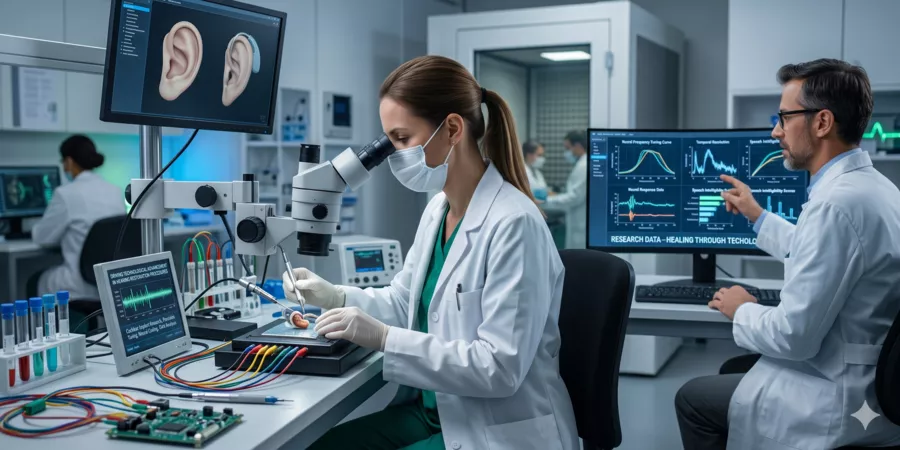
The global hearing healthcare industry is projected to surpass $15 billion by 2027, and a significant share of that growth is being driven by breakthrough innovations in restoration technology. For millions of patients who once had limited options, the pace of technological advancement in hearing restoration is opening doors that simply did not exist a decade ago.
What Technological Advancement in Hearing Restoration Really Means Today
Technological advancement in hearing restoration is no longer confined to making sounds louder. It encompasses the full spectrum of clinical innovation, from how hearing loss is diagnosed at birth to how a cochlear implant recipient learns to process speech years after activation.
Modern hearing restoration integrates surgical precision, computational intelligence, and neuroscientific understanding into a single, patient-centred treatment pathway. The result is a category of care that is more accurate, more personalised, and more outcome-driven than at any point in medical history.
Specialists working at the frontier of this field are not simply adopting new tools. They are fundamentally rethinking what it means to restore hearing at a biological and experiential level.
How AI and Machine Learning Are Reshaping Hearing Devices
Artificial intelligence has become one of the most consequential forces in modern audiology. Today’s premium hearing aids and sound processors are embedded with deep learning algorithms that analyse acoustic environments thousands of times per second, distinguishing a speaker’s voice from ambient noise with remarkable accuracy.
These AI-driven devices adapt continuously to a user’s listening habits, location patterns, and sound preferences without requiring manual adjustment. Over time, they build a personalised acoustic profile that makes every listening environment more accessible and less fatiguing for the wearer.
Beyond individual devices, machine learning is also transforming audiological diagnostics. Automated auditory brainstem response systems can now detect sensorineural hearing loss in neonates within minutes, allowing clinical teams to initiate referral pathways far earlier than traditional assessment methods permitted. Earlier detection consistently produces better long-term outcomes, making diagnostic AI one of the highest-impact applications in the field.
The Evolution of Cochlear Implant Technology
Cochlear implants represent one of the most studied and refined technologies in the history of medicine. What began as rudimentary single-channel devices in the 1970s has evolved into sophisticated multichannel systems capable of delivering nuanced sound perception across the full range of speech frequencies.
Current-generation cochlear implant systems feature:
- Slimmer, more flexible electrode arrays that reduce trauma to the delicate cochlear structures during insertion
- Wireless connectivity allowing direct audio streaming from smartphones, televisions, and hearing loop systems
- Remote programming capabilities that let audiologists fine-tune device settings without requiring the patient to travel to a clinic
- Hybrid acoustic-electric stimulation options for patients with residual low-frequency hearing
These advances collectively push cochlear implantation closer to the ideal of natural hearing, rather than a functional approximation of it. Ongoing research into totally implantable cochlear devices and optical cochlear implants using light rather than electrical stimulation signals that the technology still has significant evolution ahead.
Robotic Surgery and Precision Intervention in Cochlear Implantation
Surgical precision is a defining factor in cochlear implant outcomes. Any trauma to the cochlea during electrode insertion can damage residual hearing and affect the quality of auditory perception post-activation. This reality has driven significant investment in robotic-assisted surgical systems designed to standardise and refine the implantation process.
Robotic cochlear implant surgery systems use real-time imaging, pre-operative planning software, and micro-motion control to guide electrode arrays along the natural curvature of the cochlea with submillimetre precision. Clinical studies have demonstrated that robotic-assisted insertion reduces insertion force, minimises intracochlear trauma, and improves the consistency of electrode placement across patient anatomies.
For surgeons, these tools extend the boundaries of what is achievable manually. For patients, they translate directly into better hearing outcomes, greater preservation of residual acoustic hearing, and reduced surgical risk overall.
Tele-Audiology: Expanding Access Through Digital Infrastructure
Geographic distance has historically been one of the most persistent barriers to hearing restoration care. Patients in rural or underserved regions face compounding disadvantages, including limited access to trained audiologists, long travel times to cochlear implant centres, and delayed post-operative rehabilitation.
Tele-audiology is systematically dismantling these barriers. Remote programming platforms now allow certified audiologists to conduct mapping sessions, adjust processor settings, and monitor device performance from hundreds of kilometres away using encrypted audio-video connections and cloud-based fitting software.
The clinical outcomes achieved through remote audiology are now documented as comparable to in-person care for a growing range of procedures. This parity is critical because it means technology is not creating a two-tier system. It is actively equalising access across geographies, income levels, and mobility constraints.
The Road Ahead: What the Next Decade Holds for Hearing Restoration
The convergence of biotechnology, neuroscience, and digital engineering is positioning hearing restoration for a decade of transformative change. Research programmes currently underway are exploring gene therapy as a mechanism for regenerating damaged hair cells within the cochlea, potentially offering a biological pathway to restoration that bypasses the need for implanted devices entirely.
Brain-computer interface research is investigating direct neural stimulation methods that could one day allow sound perception without any mechanical transduction. While these technologies remain years from clinical application, their foundational science is advancing with increasing speed.
What is already clear is that the trajectory of technological advancement in hearing restoration procedures points consistently toward one outcome: a world where hearing loss is not a permanent condition but a solvable clinical challenge. The specialists, engineers, and researchers driving this progress share a common conviction that every patient deserves access to the best that science can offer, and they are building a future worthy of that belief.
Every innovation in this field begins with a refusal to accept the limits of what was possible yesterday.