Most people assume that the child who wears spectacles is the brightest in the room. The lenses sharpen vision, the answers come clearly, and the world sees intelligence confirmed. But the deaf child, answering incorrectly because the question was never fully heard, is too often dismissed. The deficit is not intellectual. It is auditory. And the distance between a wrong answer and a restored life can be measured in the intervention that nobody thought to provide.
Of the five senses, ENT surgeons are the only surgeons who can completely restore hearing.
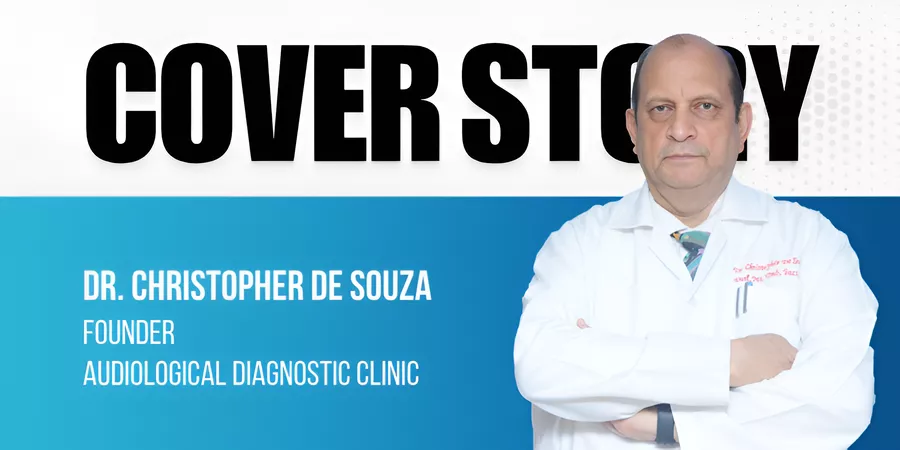
Dr Christopher de Souza has spent a career closing that distance. A specialist in Otorhinolaryngology-Head and Neck Surgery and the founder of the Audiological Diagnostic Clinic in Mumbai, he operates within what many in the field describe as the most complex anatomical corridor in the body: the space between the brain and the lungs. It is a region, in his telling, that “takes a lifetime to understand.”
Of all the organs within that corridor, it is the ear that captured his attention earliest and has never let it go. “The ear is the most fascinating organ I have ever encountered,” he says. “It is responsible not just for hearing, but also for balance, taste and movements of the muscles of the face.” That fascination with the way the ear interfaces between the external environment and the brain became the foundation for a career defined by clinical firsts, institutional transformation, and a commitment to making hearing restoration accessible to those who need it most.
A Record of Firsts
Dr. de Souza’s surgical career is marked by a series of pioneering achievements. He performed what he describes as the first cancer of the ear surgery at the Tata Memorial Hospital. He went on to perform what he identifies as India’s first cochlear implant for single-sided deafness and India’s first Bone Anchored Hearing Aid (BAHA) Ossia third-generation Implantable Hearing device. He also edited and published the world’s most comprehensive textbook on Implantable Hearing devices. What makes this achievement unusual is that the book is published in the USA under his name and is used as a reference textbook by universities across the USA and around the world.
Approximately twenty years ago, he launched newborn hearing screening programs at Holy Family Hospital in Bandra, Holy Spirit Hospital in Andheri, and Lilavati Hospital in Bandra, three of Mumbai’s most respected healthcare institutions. He also established Implantable Hearing Device programs at all three hospitals, performing the first cochlear implant at each. These efforts, he recalls, required overcoming significant resistance from those within the medical community who did not yet understand the benefits of cochlear implants for the deaf, particularly for children born without hearing. Dr. de Souza designed the Audiological Diagnostic Clinic with a clear vision. He wanted to create an environment that would not intimidate patients—a space that is non-threatening, clean, hygienic, and welcoming. The clinic is fully equipped for comprehensive ENT examinations and offers a complete range of hearing tests, reflecting a standard of care that is both genuinely friendly and thorough. As a clinical leader, Dr. de Souza dedicates himself primarily to surgical and clinical work, while delegating administrative responsibilities. He also meets regularly with his team to review progress and address any issues.
Restoring More Than Sound
The clinical record, however, tells only part of the story. For Dr. de Souza, the most meaningful moments arrive when the cochlear implant / BAHA is activated, and a patient hears again. He describes the transformation in patients who had lost their hearing and were able to hear again.
When that hearing is restored, the expressions on their faces convey a happiness that is deeply satisfying for everyone in the room. “Many patients have said, ‘I can hear, I can hear,’ when we switch the device on,” he shares. “Amazement, gratitude, and wonder echo in their voices.” In those moments, effective communication is restored, emotions run high, and everyone present is humbled by what he describes as a miracle.
This sense of purpose extends into a broader philanthropic mission. At Lilavati Hospital, Dr. de Souza established a hearing restoration program dedicated specifically to poor, marginalised, deaf female children. The program was inaugurated by Gurudeva Sri Sri Ravishankar, the founder of the Art of Living. It has received generous support from the late Mr. Ratan Tata through Tata Trusts and from Mr. Salman Khan via the Being Human Foundation. All three hospitals encourage donations and provide donors with the 80G tax exemption certificate, and Lilavati Hospital has also secured funding through crowdfunding, supported by an experienced and proactive social service department.
The Catholic Church of the Mumbai Diocese, through Cardinal Oswald Gracious, Archbishop John Rodrigues and his team and the clergy, donated a significant sum of money and equipment to support and develop this amazing endeavour centered on serving the poor and the marginalised. Many individual donors and trusts also donated graciously and generously.
The challenges facing hearing healthcare in India remain significant. Dr. de Souza identifies three primary barriers: awareness, treatment costs, and patients’ adherence to therapy and follow-up. He advocates for ongoing awareness campaigns across print and electronic media, alongside screening camps in schools and colleges to ensure effective diagnosis and treatment are available.
The Frontier Ahead
Dr. de Souza’s outlook for the future of the field is firmly optimistic. He believes that all implantable hearing devices will continue to evolve significantly and that many will eventually be placed directly into the brain’s hearing centres. Gene therapy, in his assessment, will mature and is likely to become available in the near future. “There is every reason to be optimistic that ALL hearing problems will be treated effectively, with near restoration of hearing in both ears,” he says.
He stays at the forefront of these developments through constant reading and writing, paying close attention to the evolution of changes across all disciplines of medicine and surgery, not only his own.
A Legacy Written in Sound
When asked what his recognition as India’s Leading Pioneer in Hearing Restoration and ENT Surgery, 2026, means to him, Dr. de Souza’s answer is characteristically direct. “It means I have to keep working hard to remain worthy of this honour,” he says.
His vision for his legacy is rooted in practical transformation. He wants to contribute to the restoration of hearing to improve the quality of people’s lives. For those born deaf, he views these devices as a pathway: restoring hearing so that a child can acquire speech and language, receive a comprehensive education through to postgraduate study, and access meaningful employment. The ultimate aim is to enable these individuals to contribute to their families, to society, and to the nation. His wife, Dr Rosemarie de Souza, who is also a physician and head of the department of medicine at a leading municipal hospital, has supported this endeavour, which has involved many sacrifices. Both of their daughters have also encouraged Dr Christopher to continue seeking excellence. He treasures the love and support he receives from his wife and children.
His advice to young doctors aiming to specialise in ENT surgery reflects the same philosophy. “There is no substitute for hard work,” he says. “Be a student all your life. Seek mastery over easy solutions. Be practical. Be empathetic and never hesitate to reach out to others. Goodwill is far more precious than any amount of money. Remember, medicine is a profession where we are here to serve, not be served.”
It is a fitting final word from a surgeon whose career offers a quiet but powerful argument: that restoring a single sense can reshape the trajectory of a life, and that the greatest measure of innovation is not the complexity of the technology but the dignity it returns to the people it serves.