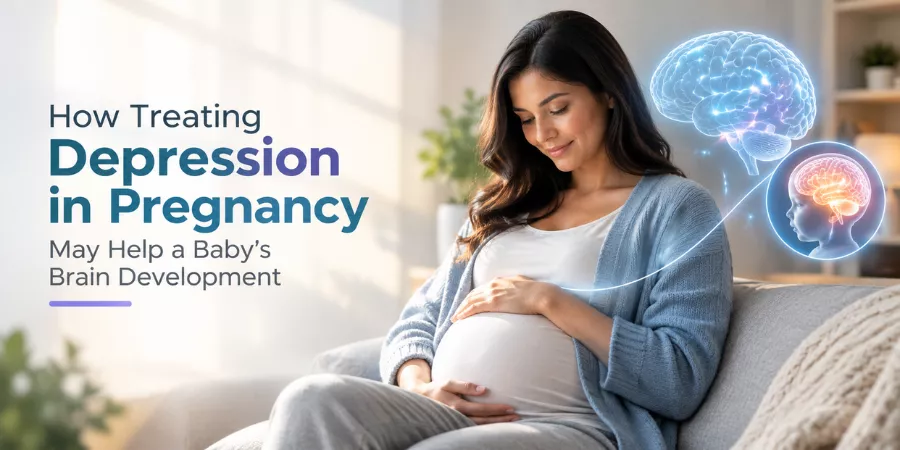
Depression in pregnancy is about more than low mood. It can make ordinary days harder to get through and strain relationships, and it can leave a mother feeling alone just when her body and life are changing fast. Now a new study suggests that treating it might also affect how her baby’s brain develops before birth.
The study, published in Nature Communications on October 16, 2026, looked at babies whose mothers had a specialised kind of talk therapy during pregnancy. These babies showed differences in a brain region tied to memory and emotional regulation. The researchers also saw a link between those differences and how the babies reacted to unfamiliar situations at six months old. It’s a good reason to take maternal mental health seriously, though nobody yet knows what it means in the long run.
What The Researchers Found
The team followed 234 pregnant women who had reported symptoms of depression at routine prenatal check-ups. All of them joined in their first or second trimester, and each was randomly placed in one of two groups.
The first group received MOMCare, a short course of interpersonal psychotherapy. It helps women manage depression by working on their relationships, easing conflict and building up their support networks. It came to eight sessions of 50 minutes each. The second group got mental health education, tips for managing symptoms and referrals to community services. Everyone kept getting their usual medical care.
Within weeks of birth, the babies had MRI scans. The infants whose mothers had MOMCare had a hippocampus that was about 5% smaller by volume than those in the comparison group.
The hippocampus helps with learning, memory and emotional regulation. But size alone doesn’t say whether a brain is developing better or worse, so the researchers checked how the babies behaved at six months. In one test, the babies met an unfamiliar toy robot that moved. Those with a smaller hippocampus tended to show less negative emotion. That hints at a connection between treating a mother’s depression, her baby’s early brain development and the baby’s emotional reactions. It doesn’t prove the brain differences will mean better mental health later on.
Why Treating Depression in Pregnancy Matters
Depression is not just feeling sad or having a rough day. It can disrupt sleep, focus and motivation, and it can make relationships and daily responsibilities feel out of reach. Pregnancy is demanding enough without that.
Scientists have studied the links between depression in pregnancy and children’s later emotional and behavioural development for a long time. Most of that work shows associations, not proof that depression causes any particular outcome. This trial adds something new by asking whether an intervention that treats depression is also linked to measurable differences in a baby’s brain.
An earlier analysis from the same project found that the share of women diagnosed with depression dropped from 36% before MOMCare to 6% afterwards. According to the researchers, the women who received the programme were also more likely to carry their babies to term.
Those results are part of why the team looked at the babies’ brains. If treatment improves a mother’s wellbeing and eases ongoing distress, it may change the conditions her baby develops in. How that might work biologically is not clear yet.
Is a Smaller Hippocampus a Good Sign?
A smaller hippocampus can sound alarming at first, but it shouldn’t be read that way without more evidence.
Brains change in size, organisation and function over time, and a scan taken shortly after birth is only a snapshot. It can’t tell us how a brain will develop over the coming months and years, or whether a given difference will matter later.
The researchers suggest that stress during pregnancy may affect the timing of certain developmental processes. Stress hormones, or the inflammation linked to depression, could play a part. Right now, those are possibilities, not established explanations.
The babies’ reactions need careful reading too. A baby who seems less upset by something unfamiliar is not necessarily less likely to develop anxiety or depression later. Many things shape infant behaviour, and it will take longer follow-up to see whether these early observations predict anything meaningful.
So, the study raises a question more than it answers one. Could effective treatment for a mother’s depression change how her baby’s brain develops, and could that matter as the child grows up?
What this Means for Prenatal Mental Health Care
The findings strengthen the case for making mental health support a routine part of pregnancy care. Regular prenatal appointments are a natural time to ask how a woman is feeling, spot signs of depression and connect her with the right help.
MOMCare is one example of how structured psychological support can work during pregnancy. Its focus on relationships and social support makes sense, because depression can change how people talk to others, stay connected and cope when things get hard.
That said, the study doesn’t show that this therapy is right for every pregnant woman. The best treatment depends on her symptoms, her medical history, her preferences and her situation. Talk therapy, medication or a mix of both may be options, and a qualified healthcare professional can help her decide.
It’s also worth saying clearly that no one should feel guilty about having depression during pregnancy. It’s a health condition, not a personal failing. What this research really adds is stronger evidence for getting help early, not extra pressure on expectant mothers.
What Researchers Still Need to Learn
The team plans to keep following the mothers and children to see whether these differences last, and whether they relate to anxiety, depression or other outcomes later in childhood.
With only 234 women in the study, larger and more diverse groups will be needed to see if the results hold up. Researchers also need to work out how the treatment might affect brain development, which biological processes are involved and whether the early differences have lasting importance.
For now, the findings give us an encouraging reason to look past the immediate symptoms of depression in pregnancy. Treatment can help women through a hard condition, and it may also matter for their babies’ earliest development. The long-term benefits aren’t proven yet, but giving pregnant women easier access to compassionate, evidence-based mental health care is still a goal worth pursuing.
Author’s POV:
When I think about pregnancy, I often notice how much attention is given to a baby’s physical health, from nutrition and medical check-ups to sleep and safety. I feel that a mother’s emotional wellbeing deserves the same attention.
We cannot expect women to navigate depression by simply telling them to stay positive, especially when they need understanding, professional help and a support system they can rely on.
What stands out to me in this research is the possibility that treating depression during pregnancy may have benefits that extend beyond the mother herself. I also believe we must be careful not to draw conclusions before researchers understand the long-term effects. For me, the most important message is: seeking help during pregnancy should never be a source of shame. Every mother deserves care for her own wellbeing, and that care may also support her baby’s development.