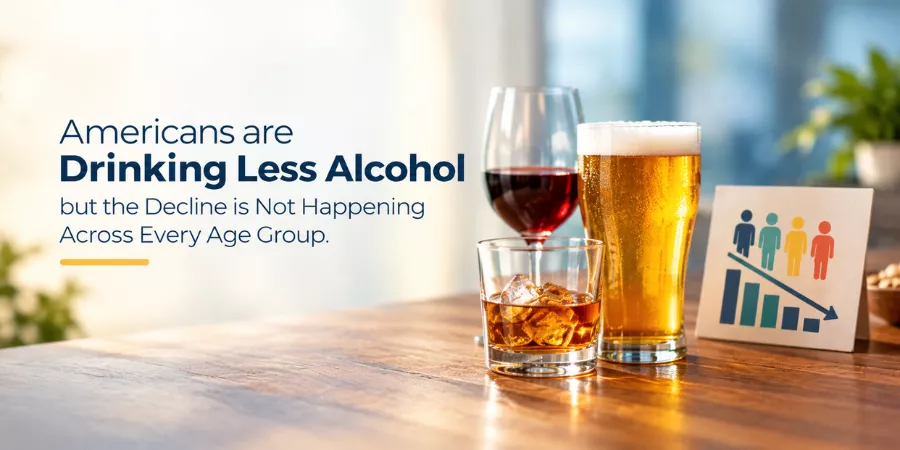
Alcohol consumption in the US has finally begun to decline after increasing during theCOVID-19crisis, but not everyone is drinking less. The trend is downward for young people, but upward for people in their 50s and early 60s.
In a new published in Annals of Internal Medicine, researchers discovered there was an overall decrease in alcohol consumption across the USA in between 2022 and 2024that is the first confirmed decrease since the covid pandemic. Heavy drinking also decreased. Though, alcohol use by 2024 was still higher than 2018 for several demographics and that there was a disturbing increase in heavy drinking for those 5064 years old.
The discoveries provide further support to general trend already present in national polls. Gallup measured in August 26 that, when asked about drinking, 54% of American adults said yes, registering the lowest point in the poll existing since 1939.
Are Americans Drinking Less Alcohol After the Pandemic?
Yes, but the decline is modest and has not returned alcohol use to pre-pandemic levels.
Researchers from Keck Medicine of USC and Thomas Jefferson University analyzed responses from 114,352 U.S. adults who took part in the CDC’s National Health Interview Survey between 2018 and 2024. Compared with 2022, both overall alcohol use and heavy drinking declined in 2024.
The decline was roughly:
- Nearly 2% lower overall alcohol use from 2022 to 2024
- More than 8% lower heavy drinking
- More than 5% lower alcohol use among Gen Z adults
- 17% lower heavy drinking among millennials
But the researchers found that drinking levels remained above 2018 levels in many groups.
So the latest alcohol consumption statistics do not describe a return to the drinking patterns seen before COVID-19. They show a gradual change after several years of elevated use.
Which Generation is Drinking the Least Alcohol?
Gen Z showed the largest decline in overall alcohol use between 2022 and 2024.
The study found that alcohol use among Gen Z adults fell by more than 5%. Millennials recorded the largest decline in heavy drinking, at 17%.
Separate federal data points in the same direction.
According to SAMHSA’s 2025 National Survey on Drug Use and Health, past-month alcohol use among Americans ages 18 to 25 fell from 50.9% in 2021 to 46.2% in 2025. Binge drinking in that age group fell from 30.0% to 26.7% over the same period.
The federal data also found that alcohol use disorder among 18-to-25-year-olds declined from 15.5% in 2021 to 13.1% in 2025.
These numbers measure different things and cover different periods from the Annals study, so they should not be treated as one continuous measurement. Together, however, they show a sustained decline in several measures of alcohol use among younger adults.
Why Are Younger Adults Drinking Less?
There is no single proven explanation for why Gen Z and millennials are drinking less.
The new Annals of Internal Medicine study identified the trend but did not establish what caused it. Researchers have discussed changing social attitudes toward alcohol as one possible explanation, but that remains an interpretation rather than a finding proved by the study.
There are signs that attitudes toward drinking are changing.
A 2026 YouGov survey found that among Americans ages 21 and older who drink alcohol, 36% said they were drinking less than they had a year earlier, while only 5% said they were drinking more. Among those cutting back, 50% cited a reduced desire to drink, 35% mentioned health concerns and 20% cited cost.
The survey does not prove that health concerns or higher prices caused the nationwide decline. It does show what people who are drinking less say about their own decisions.
Are Older Adults Drinking More Alcohol?
Some older adults are, particularly those ages 50 to 64.
This is one of the most important findings in the new research because it runs against the broader decline.
From 2018 to 2024, overall alcohol use among adults ages 50 to 64 increased by nearly 4%, while heavy drinking increased by more than 36%. Compared with 2022 alone, heavy drinking in this age group rose by about 2%.
The researchers estimate that the increase represents roughly one million additional people drinking heavily in this age group.
This means the phrase “Americans are drinking less” needs an important qualification. The national trend is downward, but it does not describe every generation.
How Has Alcohol Consumption Changed for Men and Women?
Both men and women reduced alcohol use from 2022 to 2024, but the size of the decline differed by measure.
For overall alcohol use, men recorded a 2.4% decline, compared with 1.1% among women.
Heavy drinking showed a different pattern: it declined by 9% among women and 7.7% among men.
That difference is a useful reminder that “drinking less” can mean several things. Someone may drink alcohol less frequently without necessarily changing the number of drinks consumed on the occasions when they do drink.
What Does the Latest Alcohol Consumption Data Actually Tell Us?
The strongest evidence points to a broad but incomplete shift away from alcohol, especially among younger adults.
Several datasets now show lower alcohol use among younger Americans.
SAMHSA’s 2025 survey found:
| Measure | 2021 | 2025 |
| Past-month alcohol use, ages 18–25 | 50.9% | 46.2% |
| Past-month binge drinking, ages 18–25 | 30.0% | 26.7% |
| Past-year alcohol use disorder, ages 18–25 | 15.5% | 13.1% |
At the same time, Gallup’s 2026 survey found that only 54% of U.S. adults said they drink alcohol, down from 62% in 2023 and 58% in 2024. Gallup also found that 17% of adults had substituted nonalcoholic beverages for alcohol.
The surveys use different questions and methodologies, so their percentages should not be combined as though they measure the same population in exactly the same way.
Is Drinking Less Alcohol Better for Your Health?
Reducing alcohol exposure can reduce health risks associated with drinking, but the health effects depend on how much and how often a person drinks.
Alcohol consumption is associated with several health risks, including liver disease, cardiovascular problems and certain cancers. The latest study authors noted that alcohol-related liver disease has become a major cause of liver transplantation in the U.S.
The age-related findings also matter because alcohol-related harm can become more consequential as people get older. The study’s senior author, hepatologist Brian Lee, pointed to the greater vulnerability of an aging liver to alcohol-related damage.
For people who drink, the question is therefore not simply whether alcohol consumption is rising or falling nationally. The amount, frequency and individual health circumstances all matter.
What is Driving the New Trend Toward Drinking Less?
Health concerns, lower interest in drinking and cost are among the reasons reported by Americans who have cut back.
YouGov’s 2026 data provides one of the clearest recent snapshots of those motivations. Among drinkers who said they were drinking less:
- 50% cited a reduced desire to drink
- 35% cited health concerns
- 20% cited cost
- 11% said friends or family had started drinking less
- 11% cited medication
- 6% said they no longer enjoyed the taste as much
These are self-reported reasons, not proof that any one factor is responsible for the wider national decline.
What Does the Decline in Alcohol Consumption Mean for the Future?
The U.S. appears to be moving toward lower alcohol consumption overall, but the trend is not uniform enough to describe it as a simple national retreat from drinking.
Younger adults are driving much of the decline. Federal data shows lower alcohol use, binge drinking and alcohol use disorder among young adults compared with 2021. Gallup’s long-running survey also shows the percentage of adults who drink remaining at a historic low.
Older adults present a different picture. Heavy drinking among people ages 50 to 64 has increased substantially since 2018, even as younger generations have been cutting back.
The more accurate story, then, is not that Americans have simply stopped drinking. The country is experiencing a generational and age-specific shift in alcohol use, with younger adults pulling consumption downward while some older groups continue to face rising levels of heavy drinking.
That split is likely to be more important for public-health policy than a single national percentage showing whether alcohol consumption went up or down. For people looking for healthier ways to manage everyday stress without relying on alcohol, journaling can be a simple tool for processing thoughts and emotions.
Read out article on: Journaling for Stress Relief: How Brain Dumps and Gratitude Lists Can Help