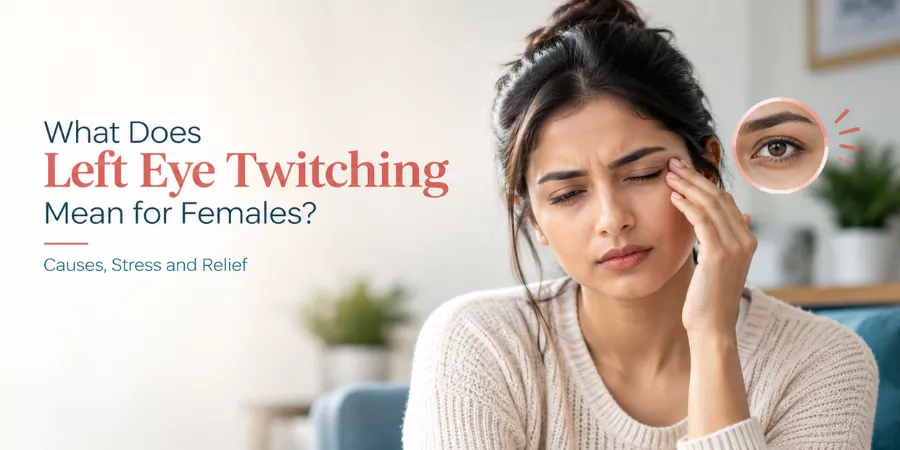
Left eye twitching in women is a brief, involuntary spasm of the eyelid muscle, medically called eyelid myokymia. It is most often linked to stress, tiredness, too little sleep, caffeine, or tired and dry eyes. Folklore attaches luck or warnings to the left eye, but the twitch itself does not predict events. In most cases it fades within days or weeks without treatment.
This article explores the common causes of left eye twitching in women, its connection to stress and workplace demands, cultural beliefs, practical relief measures, and when to seek medical advice.
What Does Left Eye Twitching Mean for Females?
Left eye twitching in females usually means the small muscles of the eyelid are firing without instruction from the brain. The sensation is a fine flutter, often felt more than seen, and it commonly lasts a few seconds to a few minutes before returning later in the day.
The left eye carries no special medical meaning compared with the right. Both eyes share the same common triggers:
- Stress and anxiety
- Short or broken sleep
- Caffeine, nicotine or alcohol
- Long hours of screen use
- Dry, itchy or irritated eyes
- Contact lens wear or eye makeup residue
- Some medications
What Do Cultural Beliefs Say About Left Eye Twitching in Women?
In several traditions, including the body-omen system known as Samudrika Shastra, a twitching left eye in a woman is commonly read as a good sign, such as pleasant news or good fortune. The rule is often reversed for men, with the right eye considered favourable. Other cultures read the same movement as a warning or a sign of emotional change.
These readings are folklore. They differ between regions, families and belief systems, and no scientific study shows that eyelid twitching predicts money, relationships, pregnancy or any future event. If the twitch keeps returning, a better use of your attention is to look at what your body has been dealing with in the past few days, such as sleep, workload and screen hours.
What Causes Left Eye Twitching in Women?
Most causes are ordinary daily factors that affect the eye muscles, the nerves that control them, or the surface of the eye. Several triggers often overlap, which explains why a twitch can continue after you fix only one of them.
Stress and emotional overload
Stress is one of the most common triggers. During tight deadlines, family pressure or long periods of worry, many women also sleep less, drink more coffee and spend more time on screens. Each of these adds to the effect of the others. A twitch cannot diagnose anxiety or burnout, but a twitch that appears every time a stressful week begins is useful information.
Sleep loss and physical fatigue
A tired body makes involuntary muscle movements more likely. Late shifts, broken sleep, night feeds with a baby and irregular routines all leave the eye muscles more prone to spasm. If the twitch began after a run of poor nights, restoring a steady sleep schedule is the first thing to try.
Approximately 30.5% of US adults reported sleeping fewer than seven hours per night in 2024, according to a CDC report published in 2026.
Eye strain from screens and close work
When you concentrate on a screen, you blink much less often. The eye surface dries out, and the muscles around the eye work harder to keep focus. Reading in dim light, driving long distances and detailed close work have the same effect.
Practical steps:
- Follow the 20-20-20 rule. Every 20 minutes, look at something about 20 feet (6 metres) away for 20 seconds.
- Place the screen slightly below eye level and match its brightness to the room.
- Blink fully and on purpose while reading or typing.
- Book an eye test if you also notice blurred vision, headaches or difficulty focusing. An uncorrected prescription is a common hidden cause of eye strain.
Caffeine and other stimulants
Coffee, tea, cola, energy drinks and nicotine can all increase muscle excitability. The effect is stronger when sleep is already short. Look at the timing: if the twitch begins within hours of a second or third cup, or after a week of higher intake, caffeine is a likely contributor. Reduce intake gradually and avoid caffeine in the afternoon and evening.
Dry eyes, irritation and medication effects
Dry eye is more common in women than in men, and hormonal changes around pregnancy, breastfeeding, perimenopause and menopause can make it more likely. Allergies, inflamed eyelid edges (blepharitis), contact lenses, eyelash extensions and leftover eye makeup can also irritate the eyelid and set off twitching.
Dry eye prevalence ranges from 5% to 50% across studies; higher in women than in men, with the gap becoming significant mainly with age according to TFOS DEWS II Epidemiology Report, The Ocular Surface, 2017.
If the twitch comes with itching, burning, a gritty feeling or crusting along the lashes, treat the irritation first. Some medications can cause involuntary muscle movements as a side effect. Ask a pharmacist or doctor to review your medicines, and do not stop a prescribed medicine on your own.
Hormonal shifts
Some women notice more eyelid twitching in the days before a period, during pregnancy or in perimenopause. Research has not established hormones as a direct cause. The more likely explanation is indirect: sleep disturbance, fatigue and dry eyes all tend to increase during these phases. If you see this pattern, a diary (described below) will show it clearly over two or three cycles.
Does Left Eye Twitching Mean a Vitamin or Mineral Deficiency?
Not on its own. Magnesium, potassium, calcium and vitamin deficiencies can affect muscle function, but an isolated eyelid twitch is not enough evidence of any of them. Taking supplements without a confirmed deficiency may not help, and some, such as high-dose magnesium or calcium, can cause side effects. If the twitch persists alongside cramps, tingling, weakness or a restricted diet, ask a doctor whether a blood test makes sense.
Can Stress Cause Left Eye Twitching in Women?
Yes. The American Academy of Ophthalmology lists stress, fatigue and caffeine among the most common triggers of eyelid twitching. Stress does not show up the same way in everyone. One woman gets headaches, another loses sleep, and another notices a twitching eyelid.
Ask yourself these questions to find your own pattern:
- Does the twitch start after several hours of uninterrupted screen work?
- Is it worse after a short night of sleep?
- Have you increased your coffee or tea recently?
- Does it appear during deadlines, conflict or long periods of worry?
- Does it ease on days when you rest more?
If you answer yes to two or more, you have probably found your triggers. This is a practical guide, not a diagnosis.
Eye Twitching and Working Conditions
Fatigue and stress often overlap for women who manage heavy workloads, caregiving and long hours at a computer. An eyelid twitch is not a validated measure of burnout, and employers should never use it to judge a person’s mental health or performance.
It can still be a sensible prompt to look at working conditions that affect physical comfort:
- Uninterrupted screen time: Build short breaks into the day and avoid back-to-back meetings.
- Long hours: Treat rest as part of the job, not a reward after it.
- Constant pressure: Plan realistic workloads and make mental health support easy to reach.
- Poor recovery time: Set clear limits on when work messages are expected to be answered.
These steps do not treat eye twitching directly, but they address the fatigue and stress that often sit behind it. Preventing burnout depends on changing demands at work, not on asking people to relax their way through excessive ones.
Employed adults working more than 60 hours a week were more likely to sleep fewer than seven hours per night (47.9%) than those working fewer than 40 hours a week (29.2%), according to the CDC’s National Health Interview Survey (2022).
How to Stop Left Eye Twitching: Relief and Prevention
Most simple eyelid twitches settle without medical treatment. These steps target the usual causes.
- Restore a regular sleep routine. Adults generally need at least seven hours a night, although individual needs vary. Go to bed and wake at similar times, including on weekends.
- Reduce eye strain. Use the 20-20-20 rule, blink fully, and fix glare and lighting. If dryness continues, ask an eye-care professional whether lubricating drops suit you.
- Cut back on caffeine gradually. A sudden stop can cause headaches, so reduce over one to two weeks.
- Use manageable stress relief. A daily walk, light exercise, slow breathing and a shorter to-do list all help. Persistent anxiety deserves professional support.
- Be gentle with the eye. A clean, comfortably warm compress for a few minutes can soothe the lid. Do not rub the eye, press on the eyeball, or use eye drops that were not recommended for you.
- Check your eye products. Remove makeup fully before bed, replace old mascara, and ask your optician about lens fit if you wear contacts.
Keep a two-week twitch diary
A simple record is the most effective way to find your trigger. Each day, note:
- When the twitch started and how long it lasted
- Hours slept the night before
- Number of caffeinated drinks and the time of the last one
- Hours of screen time
- Stress level on a scale of 1 to 5
- The day of your menstrual cycle, if relevant
Change only one or two habits at a time. If you change everything at once, you will not know what worked. This approach is more informative than trying several supplements and remedies together.
When Should You See a Doctor for Left Eye Twitching?
Occasional twitching is usually harmless, but certain signs call for a medical check. The NHS advises seeing a GP if the twitching lasts more than a few weeks, and Mayo Clinic gives similar advice. If you want a cautious personal rule, book an appointment when a twitch has continued for two weeks without any improvement.
Arrange an assessment if:
- The twitch lasts for weeks or keeps returning
- The eyelid closes completely with each spasm
- You have difficulty opening the eye
- The twitching spreads to your cheek, mouth or other parts of the face
- The eyelid droops, feels weak or stiff
- The eye is red, swollen or has discharge
Seek urgent care for sudden facial weakness, difficulty speaking, sudden vision loss or other new neurological symptoms.
How Ordinary Twitching Differs from Other Eyelid Conditions
| Condition | What it feels like | Typical course |
| Eyelid myokymia (common twitch) | Light flutter in one eyelid | Comes and goes, fades in days to weeks |
| Blepharospasm | Forceful blinking or eyelids that close and are hard to open, usually both eyes | Persistent, needs specialist care |
| Hemifacial spasm | Twitching that begins at the eyelid and spreads to the cheek and mouth on one side | Persistent, needs clinical evaluation |
If your twitching matches the second or third row, do not wait it out.
Note: Hemifacial spasm is a relatively rare condition, affecting approximately 11 people per 100,000, with a higher prevalence among women (14.5 per 100,000) than men (7.4 per 100,000), according to a study published in Archives of Neurology in 1990.
Frequently Asked Questions
What does left eye twitching mean for females spiritually?
Some traditions, including certain Indian ones, read it as a sign of good fortune or welcome news for women. Meanings vary by culture, and there is no scientific evidence that a twitch predicts events.
Is left eye twitching a sign of stress?
It can be. Stress is a recognised trigger, especially when combined with poor sleep or high caffeine intake. The twitch alone cannot confirm that stress is the cause.
How long does left eye twitching last?
A single episode lasts seconds to minutes. A bout may recur over several days, and most resolve within days or weeks. See a doctor if it continues beyond a few weeks.
Is left eye twitching a vitamin deficiency?
An isolated twitch is not enough evidence of a deficiency. If you have other symptoms or a restricted diet, speak to a healthcare professional before taking supplements.
Can hormones cause eye twitching in women?
Hormonal changes may contribute indirectly by affecting sleep and eye dryness. Direct hormonal causes have not been established.
Can workplace stress cause eye twitching?
Yes, especially with long screen hours, short sleep and heavy caffeine use. Breaks, rest and manageable workloads reduce these triggers.
Is left eye twitching different from right eye twitching?
No. The triggers are the same. The side alone does not indicate a disease, an event or a cause.
Conclusion
Left eye twitching in women is most often a temporary muscle spasm linked to tiredness, stress, caffeine or eye irritation. Cultural beliefs give it other meanings, but a medical assessment starts with how long it lasts, what other symptoms appear and what physical triggers are present.
The most useful response is to review your sleep, caffeine, screen habits and stress, and to keep a short diary. An eyelid twitch alone is not a measure of overall health or burnout. If it lasts beyond a few weeks, spreads beyond the eyelid or comes with other symptoms, see a doctor.
This article is for general information and does not replace advice from a qualified healthcare professional.
Author’s POV:
Working with screens and deadlines has made me realise how easily we begin treating tiredness as a normal part of a productive day. We postpone breaks, compromise on sleep and tell ourselves that we will rest once the work is finished. Yet our bodies do not always wait for a convenient moment to remind us that they need attention.
What stands out to me about left eye twitching is how quickly we may look for a meaning behind it without first examining our daily habits. While the twitch is usually harmless, it can be a useful reminder to pause and consider whether we have been sleeping enough, spending too long in front of a screen or carrying more stress than we acknowledge.
I believe well-being begins with paying attention rather than pushing through every discomfort. An eye twitch alone cannot tell us whether we are stressed or approaching burnout, but persistent symptoms deserve attention, not dismissal. Sometimes, the most practical step towards better health is recognising when our routines need to change.